
Lay-flat hammock or regular hammock: which is more comfortable? For a full night's sleep, most people find a lay-flat hammock more comfortable, especially side and stomach sleepers, because it holds you flat instead of curving you into a banana shape. A regular gathered-end hammock is often better for lounging and for the lightest, cheapest setup.
It also suits back sleepers who already sleep well lying diagonally. Comfort depends on setup too: a well-hung regular hammock can feel better than a badly hung lay-flat one.
Our pick: For sleeping through the night, especially on your side or stomach, choose a lay-flat hammock tent. For lounging, naps and the lightest pack, choose a regular gathered-end hammock. If you want something flatter than gathered-end but lighter than a hammock tent, a bridge hammock sits in between.

How each one feels: three kinds of hammock
A regular (gathered-end) hammock is a length of fabric gathered at each end. Your weight pulls it into a curve, so your head and feet sit higher than your hips and the sides wrap around your shoulders. Lying at an angle across it, the "diagonal lay", flattens you out a good deal, and many back sleepers sleep well that way.
A bridge hammock sits in between. Spreader bars at the head and foot hold the ends open, so you lie straight along it instead of at an angle. It's flatter than a gathered-end hammock, but the fabric still dips toward the middle and the sides rise, so it's "flatter", not flat. Most come without a rainfly or insulation.
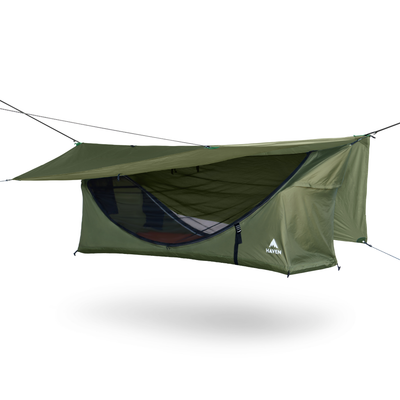
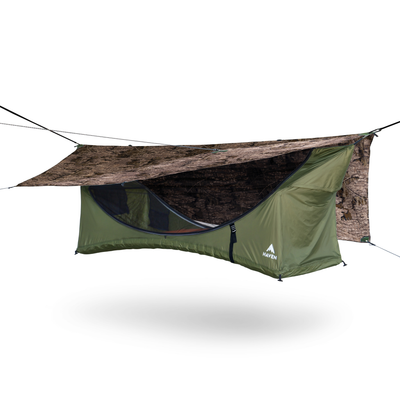
A lay-flat hammock uses some structure to keep the sleeping surface level. In a Haven, two support arcs keep the side walls low, spreader bars stop the sides closing in, a ridgeline holds the shape whatever the tree spacing, and an insulated air mattress makes a firm platform. The result feels closer to a bed than a sling. The design post explains each part.
What is shoulder squeeze?
Shoulder squeeze is the pressure you feel when the sides of a hammock pull in around your shoulders. The fabric is under tension along its length, and your weight draws the edges up and inward. Broad-shouldered people and side sleepers notice it most. A wider hammock and a proper diagonal lay reduce it in a gathered-end hammock; a bridge hammock's spreader bars reduce it further. A lay-flat hammock tent avoids most of it by holding the side walls open (in a Haven, with spreader bars and side support arcs), so your shoulders lie on the pad rather than against fabric.
Comfort by sleeping position
| Regular gathered-end hammock | Bridge hammock | Lay-flat hammock (Haven) | |
|---|---|---|---|
| Back | Good for many people, lying diagonally | Good for many people; you lie straight | Flat, level platform |
| Side | Hard for most: the curve and squeezed shoulders | Possible for some; the middle still dips | Designed for it |
| Stomach | Very hard; your back arches the wrong way | Hard for most, because of the sag | Possible, as on a firm mattress |
| Rolling over | Awkward; the fabric shifts with you | Easier than gathered-end | Roll over as you would at home |
| Lounging and sitting | Excellent; this is what it's made for | Fine for lying back; less of a cocoon | Sit on the edge or lie back; the Safari and Spectre have a lounge strap that turns the bed into a reclined seat |
Stability, tippiness and getting in
A regular hammock is stable when it hangs with a deep sag, but that's what bends you into the banana shape. Pull it tight to flatten it and it gets tippy. A Haven keeps its anchor points high above the sleeping platform and carries the tension down the side arcs, so you get a flat bed that doesn't tip. You get in by sitting on the low side wall and lying back, and you can hold the ridgeline while you do. More in What Makes a Hammock Stable, or Not?
If a lay-flat hammock ever feels like it leans, it's usually the setup rather than the design: the pad has shifted off center (push it back to the middle), heavy gear is piled at one end, or the hang angle is off (aim for 15 to 30 degrees on the straps; see the hang angle guide). Don't sit or stand on the spreader bars; they hold the sides open but aren't built to carry your weight.
Lounging, sitting and daytime use
For an afternoon read or a nap, a gathered-end hammock is hard to beat: it wraps around you, swings easily and goes up in a minute. A lay-flat hammock is built for the night. During the day you can sit on the edge or lie back, and the Safari and Spectre lounge strap props you up in a reclined seat. If most of your hammock time is daytime lounging, the regular hammock is the better buy.
What you need for an overnight
For a night out, a regular hammock needs extras: tree straps, a bug net, a tarp, and an underquilt or pad for warmth. Each one is a separate purchase and something to set up. A Haven kit comes with the bug net, rainfly, straps, guylines, stakes and an insulated air mattress; you add your sleeping bag and pillow. See the gear checklist for a side-by-side list.
Where a regular hammock does better
- Weight and pack size. A bare gathered-end hammock is much lighter and smaller than any lay-flat hammock tent.
- Price. A basic hammock costs far less up front, even after you add a tarp and net.
- Lounging. For an afternoon in the shade, the cocoon feel is the point.
- Simplicity. Two straps and you're hanging.
- Weight capacity. The ENO and Kammok hammocks we compared are rated higher than a Haven's 285 lb (350 lb for the Safari); see Haven vs Kammok and ENO, and check each maker's rating.
Where a lay-flat hammock does better
- Sleeping on your side or stomach.
- Not spending the night in a curve, with the sides pressing on your shoulders.
- Warmth, because the insulated pad is built in.
- One kit instead of matching a net, tarp and insulation.
Which should you choose?
- You mostly lounge, nap or backpack light, and sleep on your back: a regular hammock, hung with a good sag and slept in diagonally.
- You want to sleep through the night on your side or stomach: a lay-flat hammock such as the Haven Tent or Haven XL.
- You want something in between: a bridge hammock is flatter than a gathered-end one and lighter than a Haven (see Haven vs Warbonnet and Amok).
Common questions
Is a lay-flat hammock more comfortable than a regular hammock?
For sleeping through the night, usually yes, especially on your side or stomach, because you lie flat instead of in a curve. For lounging and naps, many people prefer a regular gathered-end hammock.
Can you sleep on your side in a regular hammock?
Some people can, lying diagonally in a wide hammock, but most side sleepers find the curve and shoulder squeeze hard to sleep through. A bridge hammock is flatter; a lay-flat hammock tent is level.
Are lay-flat hammocks tippy?
A Haven is built to be stable: the anchor points sit high above the sleeping platform, which hangs from arcs along the sides. You get in by sitting on the low side wall and lying back. If it leans, re-center the pad and spread out your gear.
Is a bridge hammock the same as a lay-flat hammock?
No. A bridge hammock uses spreader bars to make a flatter lay, but the fabric still sags toward the middle. A lay-flat hammock tent keeps the platform itself level with structure and a fitted pad.
Not sure a lay-flat hammock is worth it for you? Read Are Lay-Flat Hammocks Worth It?, Can You Sleep Flat in a Hammock? and the brand comparison Haven vs Kammok and ENO. To compare a Haven with a ground tent, see Haven vs Ground Tents, and see every model on our outdoor sleep systems page.


Comments (0)
No comments yet — be the first!
Leave a Comment