Can You Sleep Flat in a Hammock?
Haven Tents · October 21, 2026 · 3 min read

Can you sleep flat in a hammock? Not in a traditional gathered-end hammock. Lying diagonally gets you much flatter than lying straight, but there's still a curve and the sides press in. Bridge hammocks, with a spreader bar at each end, are flatter again, though the fabric still dips in the middle. To sleep truly flat you need a lay-flat hammock, which holds a firm sleeping platform level below its anchor points. That's what lets back, side and stomach sleepers sleep the way they do at home.
Why most hammocks aren't flat
A hammock is fabric hanging between two points, and hanging fabric takes a curve. When you lie along the middle of a gathered-end hammock, your head and feet end up higher than your hips, and the sides wrap in around your shoulders. Some people sleep fine like that. Many, especially side and stomach sleepers, don't.
Three ways to get flatter
1. Lie diagonally in a gathered-end hammock
Hang the hammock with a good sag (about a 30° strap angle is the common starting point) and lie at an angle across it, head to one side and feet to the other. This pulls the fabric tighter under you and takes out much of the curve. It's the standard trick, and it works best in wide hammocks. You're still in a shallow curve, though, and rolling onto your side or front is awkward.
2. Use a bridge hammock
A bridge hammock has spreader bars at the head and foot, so the bed is more rectangular and you lie straight along it. It's flatter than a gathered-end hammock and many back sleepers like it. The fabric still sags toward the middle, the sides still rise, and you usually add your own pad or underquilt, tarp and bug net.
3. Use a lay-flat hammock
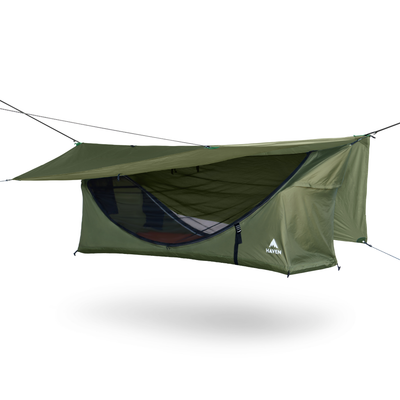
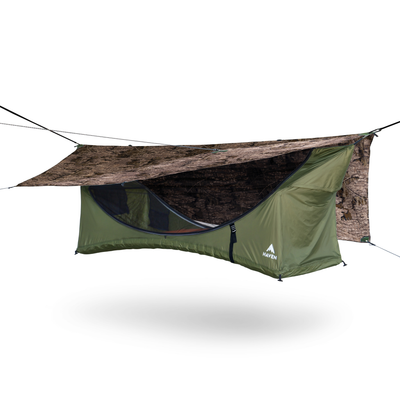
A lay-flat hammock is designed so the sleeping platform itself stays level. In a Haven, an insulated air mattress gives a firm surface and its horizontal baffles hold the sides open; two support arcs carry the load like the cables of a suspension bridge, with the platform hanging below them; spreader bars open the ends; and a structural ridgeline keeps the shape the same whatever the tree spacing. The fabric is cut so the platform bows slightly upward until you lie on it and it settles flat. The full explanation is in The Secret Design Behind the Haven Tent.
Flatness compared
| Gathered-end (diagonal lay) | Bridge hammock | Lay-flat hammock tent |
|---|
| How flat | Flatter than lying straight, still curved | Flatter, some sag in the middle | Flat platform |
| Shoulder squeeze | Common | Less | Sides held open |
| Side and stomach sleeping | Hard for most | Possible for some | Yes |
| Insulation underneath | Underquilt or pad, bought separately | Pad or underquilt, bought separately | Insulated pad included |
| Bug net and rainfly | Usually separate | Usually separate | Included |
| Weight and bulk | Lightest | Middle | Heaviest of the three |
Tips for sleeping flat in a Haven
- Get the hang angle right. Aim for 15 to 30 degrees on the straps (hang angle guide). Keep it low to the ground (hang safe).
- Inflate the pad fully and top it off at bedtime; a soft pad lets your hips sink.
- Center the pad. If you feel yourself leaning, the pad has shifted; push it back to the middle (how).
- Balance heavy gear. A lot of weight at one end can tip the platform toward it.
Is flat always better?
Not for everyone. A lay-flat hammock is heavier and bulkier than a bare hammock, and each one sleeps one person. If you already sleep well on a diagonal lay, there's no need to switch. If you've tried hammocks and couldn't sleep, flat is usually what was missing. Weigh it up in Are Lay-Flat Hammocks Worth It? and Lay-Flat vs Regular Hammock, or read our guides for side sleepers and stomach sleepers. To see how a Haven compares with a tent and pad, go to Haven vs Ground Tents or the outdoor sleep systems page.
← Back to Adventure Journal
<div class="dynamic-checkout__content" id="dynamic-checkout-cart" data-shopify="dynamic-checkout-cart"> <shopify-accelerated-checkout-cart wallet-configs="[{"supports_subs":true,"supports_def_opts":false,"name":"shop_pay","wallet_params":{"shopId":11057397823,"merchantName":"Haven Tents","personalized":true}},{"supports_subs":false,"supports_def_opts":false,"name":"amazon_pay","wallet_params":{"checkoutLanguage":"en_US","ledgerCurrency":"USD","placement":"Cart","sandbox":false,"merchantId":"A21KZNDFJ6EOT6","productType":"PayAndShip","design":"C0002"}},{"supports_subs":true,"supports_def_opts":false,"name":"paypal","wallet_params":{"shopId":11057397823,"countryCode":"US","merchantName":"Haven Tents","phoneRequired":true,"companyRequired":false,"shippingType":"shipping","shopifyPaymentsEnabled":true,"hasManagedSellingPlanState":false,"requiresBillingAgreement":true,"gatewayType":"CONNECTED","merchantId":"AT9YPQVBATPVS","sdkUrl":"https://www.paypal.com/sdk/js?components=buttons\u0026commit=false\u0026currency=USD\u0026locale=en_US\u0026client-id=AexZEtAxk09Ncgj6FSWFFyGKbxxAZ_LTyJ2DPdJWl1YUlecinmc5AfIaRF2qYjWlusWahlzz6SVkY5Ci\u0026merchant-id=AT9YPQVBATPVS\u0026intent=authorize","serviceableCountryCodes":["AC","AD","AE","AF","AG","AI","AL","AM","AO","AR","AT","AU","AW","AX","AZ","BA","BB","BD","BE","BF","BG","BH","BI","BJ","BL","BM","BN","BO","BQ","BR","BS","BT","BW","BY","BZ","CA","CC","CD","CF","CG","CH","CI","CK","CL","CM","CN","CO","CR","CV","CW","CX","CY","CZ","DE","DJ","DK","DM","DO","DZ","EC","EE","EG","EH","ER","ES","ET","FI","FJ","FK","FO","FR","GA","GB","GD","GE","GF","GG","GH","GI","GL","GM","GN","GP","GQ","GR","GS","GT","GW","GY","HK","HN","HR","HT","HU","ID","IE","IL","IM","IN","IO","IQ","IS","IT","JE","JM","JO","JP","KE","KG","KH","KI","KM","KN","KR","KW","KY","KZ","LA","LB","LC","LI","LK","LR","LS","LT","LU","LV","LY","MA","MC","MD","ME","MF","MG","MK","ML","MM","MN","MO","MQ","MR","MS","MT","MU","MV","MW","MX","MY","MZ","NA","NC","NE","NF","NG","NI","NL","NO","NP","NR","NU","NZ","OM","PA","PE","PF","PG","PH","PK","PL","PM","PN","PS","PT","PY","QA","RE","RO","RS","RU","RW","SA","SB","SC","SD","SE","SG","SH","SI","SJ","SK","SL","SM","SN","SO","SR","SS","ST","SV","SX","SZ","TA","TC","TD","TF","TG","TH","TJ","TK","TL","TM","TN","TO","TR","TT","TV","TW","TZ","UA","UG","UM","US","UY","UZ","VA","VC","VE","VG","VN","VU","WF","WS","XK","YE","YT","ZA","ZM","ZW"]}}]" access-token="20cee07b2f5277b40ccae45e245d3c77" buyer-country="US" buyer-locale="en" buyer-currency="USD" shop-id="11057397823" cart-id="b4b52a89e6256ae97a2b09692d3ddd7d" enabled-flags="["a1d1f9a1","f5afabb3","370070f3","b311f899"]" > <div class="wallet-button-wrapper"> <ul class='wallet-cart-grid wallet-cart-grid--skeleton' role="list" data-shopify-buttoncontainer="true"> <li data-testid='grid-cell' class='wallet-cart-button-container'><div class='wallet-cart-button wallet-cart-button__skeleton' role='button' disabled aria-hidden='true'> </div></li><li data-testid='grid-cell' class='wallet-cart-button-container'><div class='wallet-cart-button wallet-cart-button__skeleton' role='button' disabled aria-hidden='true'> </div></li><li data-testid='grid-cell' class='wallet-cart-button-container'><div class='wallet-cart-button wallet-cart-button__skeleton' role='button' disabled aria-hidden='true'> </div></li> </ul> </div> </shopify-accelerated-checkout-cart> </div>



Comments (0)
No comments yet — be the first!
Leave a Comment