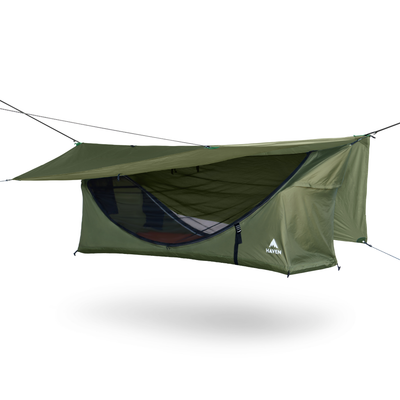
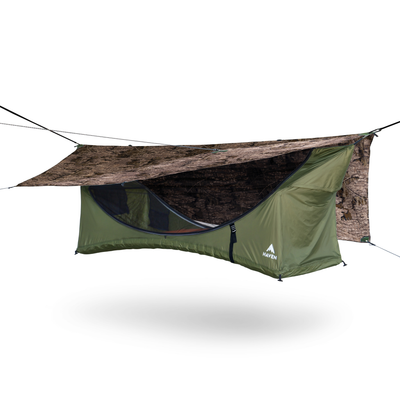
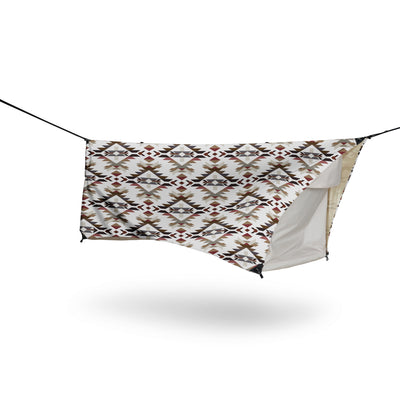
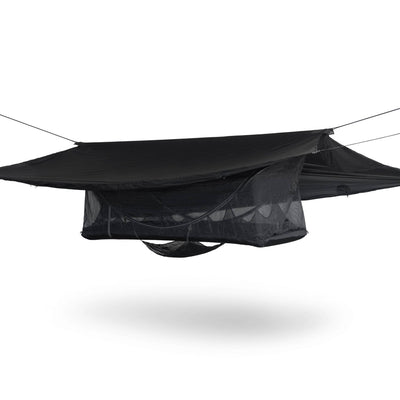
Short answer: a tent and sleeping pad suits most campers, and it is the better choice if you need shared space for several people, camp where there are no trees and don't want to carry a stand, need to sit out long storms inside, or want the lightest possible 1-person shelter. A Haven lay-flat sleep system is the better fit if you want to sleep flat and off rocks, roots and wet ground, especially as a side or stomach sleeper; one kit replaces both your tent and your sleeping pad. Below we compare complete setups (tent plus pad versus Haven) on comfort, weight, setup, weather and cost, including where ground tents win.
Haven isn't a typical hammock tent. It's a complete tent + pad replacement system designed specifically to make sleep the highlight of camping, not an afterthought.
Even a premium $500-700 ground tent still needs a separate sleeping pad, and the pad does all the comfort work. On the ground, many campers, especially side sleepers, feel pressure at the hips and shoulders, and air pads can slide around or soften as the night cools. The tent provides shelter; it doesn't change what you sleep on.
02
Why This Matters
Most campers try to fix sleep with a better pad rather than a different shelter. Haven takes a different approach: a stable, flat, supported sleep surface that is part of the shelter itself.
The problem
Where Ground Tents + Pads Fall Short for Sleep
The outdoor industry has spent decades perfecting tent designs: lighter fabrics, better pole systems, improved weather protection. But you still sleep on the ground, on a pad that has to do all the comfort work.
01
Pads Do All the Comfort Work
On the ground, a pad compresses most under your hips and shoulders, which is where many side sleepers feel pressure. Air pads can also slide, soften as the night cools, and make noise when you move.
02
Ground Contact Ruins Sleep
Rocks, roots, and uneven terrain transfer through the tent floor and pad, and cold ground draws heat through any pad with too low an R-value. Even on "flat" ground, you're working against ground contours that a pad can only partly smooth out.
03
Tents Don't Address the Real Problem
A $700 ultralight tent still needs a separate $100-200 pad. Premium tents bring better weather protection and lower weight, but the tent doesn't change what you sleep on: comfort still depends on the pad and the ground beneath it.
Ground Tent + Sleeping Pad
Pad can create pressure points on hips/shoulders
Side sleeping often uncomfortable
Pad can slide, lose air or make noise
Cold ground draws heat through a low R-value pad
Rocks and roots felt through pad
Two separate systems to buy, carry, set up
Haven Tent Sleep System
A flat, evenly supported surface that reduces pressure on hips and shoulders compared with a pad on the ground
Side, back, stomach—sleep naturally
Pad is shaped to the frame so it stays centered
Warmth from the insulated pad (R2.5-R5.3) and your sleeping bag
No rocks, roots, or uneven ground
Single system replaces tent + pad
Side by side
Haven vs Popular Ground Tents
Here's how Haven compares with popular ground tents as complete sleep setups (tent plus pad). The tents below sleep two or three people; every Haven sleeps one, so for a group compare one Haven per person. Specs from manufacturer websites, checked October 2026. Some links are affiliate links.
Weight: 3 lb 2 oz | 1420 g (packed) + 1-2 lb pad = 4-5 lb total | 1814-2268 g
Floor Space: 29 sq ft | 2.7 m²
Setup: 10-15 min with stakes, poles, rainfly
Cost: $550 tent + $100-200 pad = $650-750
Capacity: 2-person tent
Sleep Quality: Requires a separate sleeping pad. Comfort depends on that pad and the ground under the ultralight 20D floor.
Haven Tent
Weight: 5 lb 13 oz | 2643 g* complete system
Sleeping Platform: 78" x 24" | 198 x 61 cm lay-flat design
Setup: About 5 minutes once you've practiced (your first setup takes longer)
Cost: $388 complete system (add your sleeping bag)
Capacity: 1-person system
Sleep Quality: Integrated insulated pad (up to R5.3) provides genuine flat sleeping surface. Waterproof hammock body. A flat, evenly supported surface that reduces pressure on hips and shoulders compared with a pad on the ground. Off the ground, so rocks, roots and ground moisture aren't an issue. Warmth comes from the insulated pad (R2.5-R5.3; add the pad cover for cold nights) and your sleeping bag.
The Sleep Problem:
The Copper Spur is an excellent ultralight 2-person tent, with shared space a single Haven doesn't offer, and with a pad it weighs about the same as or less than a Haven. What it can't change is the surface you sleep on: comfort still depends on your pad and the ground. As a tent + pad setup ($650-750), it also costs more than a Haven Tent kit.
Weight: 4 lb 13 oz | 2180 g + 1-2 lb pad = 5-7 lb total | 2268-3175 g
Floor Space: 47 sq ft | 4.4 m²
Setup: 10-15 min with stakes, hubbed poles
Cost: $630 tent + $100-150 pad = $730-780
Capacity: 3-person tent
Sleep Quality: Up to three people share one space, each on their own pad; comfort depends on those pads and the ground.
Haven XL
Weight: 5 lb 15.7 oz | 2713 g* per unit
Sleeping Platform: 80" x 30" | 203 x 76 cm per person
Setup: About 5 minutes per unit once you've practiced (your first setup takes longer); hang side-by-side
Cost: $387 complete system
Capacity: 1-person system
Sleep Quality: Each person gets private, comfortable lay-flat sleeping. Waterproof hammock body on each unit. No snoring in your ear. No shoulder rubbing. Set up close but sleep separately in comfort.
The Sleep Problem:
The Hubba Hubba LT 3 is a roomy 3-person tent with shared space to hang out in. A Haven XL sleeps one, so the like-for-like comparison is three Haven XLs hung side by side against one tent plus three pads. Three Havens cost and weigh more in total, but each person gets their own flat bed and doesn't feel the others move.
Weight: 3 lb 15 oz | 1780 g + 1-2 lb pad = 5-6 lb total | 2268-2722 g
Floor Space: 30.6 sq ft | 2.84 m²
Setup: 10-15 min with stakes, poles, rainfly
Cost: $500 tent + $100-200 pad = $600-700
Capacity: 2-person tent
Sleep Quality: OSMO fabric is eco-friendly and weather-resistant. A separate sleeping pad is required, and comfort depends on that pad and the ground under the 20D floor.
Haven Tent
Weight: 5 lb 13 oz | 2643 g* complete system
Sleeping Platform: 78" x 24" | 198 x 61 cm lay-flat design
Setup: About 5 minutes once you've practiced (your first setup takes longer)
Cost: $388 complete, insulated pad included
Capacity: 1-person system
Sleep Quality: Integrated insulated pad (up to R5.3) provides lay-flat comfort. Waterproof hammock body. Sleep on your side, back, or stomach naturally. Off the ground, so rocks, roots and ground moisture aren't an issue. Warmth comes from the insulated pad (R2.5-R5.3; add the pad cover for cold nights) and your sleeping bag.
The Sleep Problem:
The Dagger OSMO is a spacious 2-person tent. You still need a separate $100-200 pad, and comfort depends on that pad and the ground. At $600-700 for tent + pad it costs more than a Haven Tent kit, which includes its insulated pad; the Dagger gives two people shared space at a similar total weight.
Weight: 4 lb 11 oz | 2126 g (includes footprint) + 1-2 lb pad = 6-7 lb total | 2722-3175 g
Floor Space: 33.75 sq ft | 3.14 m²
Setup: 10-15 min with stakes, poles, rainfly
Cost: ~$350-400 tent + $100-200 pad = $450-600
Capacity: 2-person tent
Sleep Quality: Spacious interior and good value. A separate sleeping pad is required, and the 40D floor still follows the ground's contours.
Haven Tent
Weight: 5 lb 13 oz | 2643 g* complete system
Sleeping Platform: 78" x 24" | 198 x 61 cm lay-flat design
Setup: About 5 minutes once you've practiced (your first setup takes longer)
Cost: $388 complete system
Capacity: 1-person system
Sleep Quality: Integrated insulated pad (up to R5.3), so no separate sleeping pad to buy. Waterproof hammock body. Off the ground, so rocks, roots and ground moisture aren't an issue. Warmth comes from the insulated pad (R2.5-R5.3; add the pad cover for cold nights) and your sleeping bag.
The Sleep Problem:
The Half Dome is good value and roomy for two. Add a $100-200 pad and the total is $450-600, similar to or more than a Haven Tent kit, which includes its insulated pad. The Half Dome wins on shared space; Haven is built for a flat, off-ground bed for one.
Weight: 7 lb 14 oz | 3566 g + 1-2 lb pad = 9-10 lb total | 4082-4536 g
Floor Space: 42.5 sq ft | 3.95 m²
Peak Height: 48 in | 122 cm—can sit up
Cost: ~$400-500 tent + $100-150 pad = $500-650
Capacity: 3-person tent
Sleep Quality: Spacious and tall, with room for three to sit up. Each sleeper needs a pad; the durable 68D floor still follows the ground. Heavy for backpacking.
Haven Safari
Weight: 9 lb 2 oz | 4140 g* per unit
Sleeping Platform: 80" x 30" | 203 x 76 cm lay-flat per person
Peak Height: ~36 in | 91 cm inside—plenty of space to sit up comfortably. Sleeping flat is the goal.
Cost: $440 complete system
Capacity: 1-person system
Sleep Quality: Each person gets heavy-duty lay-flat comfort. Waterproof hammock body on each. Private space. No snoring. Rated for one person up to 350 lb | 158 kg; stress-tested well past that. Built for rugged off-grid use.
The Sleep Problem:
The Mineral King 3 is a tall, durable 3-person tent with room to sit out bad weather together, which a Haven doesn't offer. For three sleepers, the like-for-like comparison is three Haven Safaris against one tent plus three pads: Haven costs more in total but gives each person a private, heavy-duty flat bed.
At a glance
Complete System Comparison
Compare complete systems: a ground tent plus sleeping pad versus a Haven kit. Weights and prices are ranges across models; check each product page for your exact configuration.
Factor
Ground Tent + Sleeping Pad
Haven Integrated System
Sleep Quality
Pad can create pressure points on hips/shoulders; side sleeping often uncomfortable; air pads can slide or lose air
A flat, evenly supported surface that reduces pressure on hips and shoulders compared with a pad on the ground; sleep on your back, side or stomach Lay-flat
Sleep Position
Back sleepers often do fine on a thick pad over smooth ground. Side and stomach sleepers put more weight on hips and shoulders, where a pad on the ground compresses most.
Back, side or stomach on a flat platform, with the pad held in place by the frame. Gathered-end hammocks, by contrast, suit back sleepers best Any position
Tent bag + separate pad + stakes = 2-3 items, ~15-20L
Single system, ~8-12L (pad packs separately) Compact
Setup Time
Stake out, assemble poles, attach rainfly, inflate pad = 10-15 min
Hang straps, clip tent, insert pad = about 5 minutes once you've practiced (your first setup takes longer) Faster
Ground Contact
Rocks, roots, uneven ground felt through pad; ground cold transfers
Off the ground, so rocks, roots and ground moisture aren't an issue. Warmth comes from the insulated pad (R2.5-R5.3; add the pad cover for cold nights) and your sleeping bag Off-ground
Setup Options
Requires flat ground, no rocks/roots, tent footprint recommended
Trees or modular stand; uneven/rocky terrain OK; also works as ground bivy Versatile
Weather Protection
Condensation buildup, water pooling, moisture from ground
Waterproof hammock body (except Spectre) + rainfly. Elevated ventilation, no ground moisture Drier
Durability
Floor tears from rocks/sticks, pole breakage, zipper strain
No floor to wear through; rated 285-350 lb | 129-158 kg per person and stress-tested well past that; reinforced suspension No floor
Insulation
Separate pad required, cold from ground, R-values vary
Integrated insulated pad (up to R5.3, add-on cover available) Built-In
Complete Cost
$350-700 (tent) + $100-200 (pad) = $450-900
$387-491 with tent, pad and rainfly included (add your sleeping bag) Pad included
Ground Critter Safety
Scorpions, snakes, insects can crawl under or through openings
Off the ground with a zip-closed bug net, which keeps out most crawling insects Protected
*Trail weight includes only the essentials—hammock body, spreader bars, carabiners, and straps—without packaging. This is the actual weight you carry on the trail.
The Haven approach
How Haven Solves the Sleep Problem
Here's how Haven's integrated design addresses the main comfort problems of a ground tent and pad.
01
Genuinely Flat Sleep Surface
Instead of a pad compressing on uneven ground, Haven's patented lay-flat design holds its pad flat in a suspended frame. Sleep on your side, back, or stomach, much like in your bed at home. A flat, evenly supported surface that reduces pressure on hips and shoulders compared with a pad on the ground.
02
Integrated Insulation System
No separate pad to buy: Haven integrates an insulated pad directly into the design (up to R5.3, add-on cover available). The pad itself is your insulation underneath, and the Insulated Pad Cover adds insulation under your core: Haven is 3-season with the insulated pad, and 4-season with the Insulated Pad Cover.
03
Quick Setup
Wrap the tree straps, clip in the suspension, insert the pad. That's it. About 5 minutes once you've practiced (your first setup takes longer). The rainfly packs already attached to the tent. The pad clips to the tent bag with a flap, keeping everything together in one package. No poles to assemble, no stakes to hammer.
04
Complete System—Not Two Products
Haven replaces your tent AND sleeping pad with a single, integrated system. No buying two products. No compatibility concerns. No separate setup steps. One system that weighs 4.3-9.1 lbs | 1953-4140 g* complete. Spectre's lightest kit is 4 lb 5 oz (1.95 kg) including its pad, in the range of many 2-person backpacking tent + pad setups (about 4-6 lb). Ultralight 1-person shelters can be lighter.
05
Off the Ground
Suspended above the ground means no rocks, no roots, no uneven terrain, and no moisture seeping from below. Warmth comes from the insulated pad (R2.5-R5.3; add the pad cover for cold nights) and your sleeping bag. Bonus: with no floor sitting on wet ground, there's usually less to dry before you pack up.
06
Built to Last
No tent floor to wear through on rocks. Rated for one person up to 285-350 lb depending on model, and stress-tested well past that. Reinforced attachment points and quality materials.
07
Enjoy the Views You Worked to Reach
Why hike to beautiful places only to crawl into a windowless cave? Haven's low sidewalls let you actually see outside and enjoy nature. The waterproof hammock body (except Spectre) protects you while the rainfly rolls up or down from inside for stars and fresh air—or quick deployment when weather turns. Spectre features 360° high-quality mesh for unobstructed views in every direction.
Honest trade-offs
When Ground Tents Make More Sense
Haven excels at solving the sleep problem—but we're honest about where ground tents have advantages.
01
Multi-Person Shared Space
Haven is a single-person system. If you want multiple people sharing one shelter (playing cards, hanging out during a storm), a ground tent provides more communal space. Haven gives everyone private, comfortable sleep—but not a shared living room.
02
Guaranteed Treeless Environments
Haven is designed for trees and performs best when suspended. While it can use our Haven Stand (17.1 lbs | 7.75 kg, ideal for car camping) or work as a ground bivy, if you're camping somewhere you KNOW will be treeless and you don't want to carry a stand, a ground tent is simpler.
03
All-Day Storm Shelter
If you're permanently stuck in your shelter during severe weather, ground tents offer more interior space to move around and sit up. Haven is optimized for sleeping—the activity that matters most. But if you need to spend 12 hours awake in your shelter, a ground tent provides more livability.
04
Lowest Possible Pack Weight
If the absolute lowest weight is your priority, an ultralight 1-person ground shelter with a thin pad can total 1-3 lb | 454-1361 g, lighter than any Haven. Haven Spectre's lightest kit is 4 lb 5 oz | 1953 g including its pad, which is in the range of many 2-person tent + pad setups.
Choose your Haven
Which Haven Is Right for Your Adventure?
Here's how to choose between the four Haven models for the way you camp.
Backpacking & Thru-Hiking
For long-distance hiking where every ounce counts, Haven Spectre delivers ultralight performance without sacrificing comfort. At 4 lb 5 oz | 1953 g* trail weight (with optional Dyneema rainfly upgrade) with the larger 80" x 30" | 203 x 76 cm platform and integrated insulation, it's in the range of many 2-person backpacking tent + pad setups (about 4-6 lb). Ultralight 1-person shelters can be lighter. Features 360° high-quality mesh for unobstructed views.
When weight isn't an issue, Haven Safari is our most heavy-duty model: 300d polyester, rated for one person up to 350 lb | 158 kg. The Haven Tent and Haven XL work for car camping too, and are lighter if you also backpack.
No trees? No problem. Any Haven model works with our Haven Stand (17.1 lbs | 7.75 kg—best for car camping). Or use Haven in ground mode as a bivy tent—lay it flat on the ground for protection when suspension isn't possible.
All Haven models feature integrated insulated pads (up to R5.3, add-on cover available). Warmth comes from the insulated pad and your sleeping bag: Haven is 3-season with the insulated pad, and 4-season with the Insulated Pad Cover. Pair with a quality sleeping bag rated for your conditions.
Haven XL accommodates taller campers and those who want extra space with its 80" x 30" | 203 x 76 cm platform. Set up multiple Havens side-by-side for groups—everyone gets private, comfortable sleep without sharing a cramped tent or listening to snoring.
Haven Safari is built for rough use: heavy-duty materials with the larger 80" x 30" | 203 x 76 cm platform, rated for one person up to 350 lb | 158 kg. When your adventure takes you far from civilization, it's the Haven built to take the most wear.
Straight answers to the questions we hear most about Haven versus a tent and pad.
Can a sleeping pad alone make ground camping comfortable?
For some people, yes, especially back sleepers on a thick pad over smooth ground. Many side sleepers still feel pressure at the hips and shoulders, because a pad on the ground compresses most where you're heaviest. Haven combines its insulated pad with a lay-flat suspended frame, which gives you a flat, evenly supported surface that reduces pressure on hips and shoulders compared with a pad on the ground.
Is an all-in-one sleep system better than a tent and pad?
Not for everyone. A tent, pad and sleeping bag is already a sleep system, and if you sleep well in yours, keep it. Separate parts are more flexible and can be shared. An all-in-one system like a Haven is simpler to pack and set up and is built around sleeping flat, which matters most if you sleep on your side or stomach or wake up sore on the ground.
Yes. Unlike gathered-end hammocks, which curve you into a banana shape, Haven's lay-flat platform lets you sleep on your side, back, or stomach, much like a regular bed. That's the key difference from a pad on the ground, where many side sleepers feel pressure at the hips and shoulders.
Is a Haven better than a pad if I have back or joint pain?
It may be more comfortable for some people, but we can't promise it will help a medical condition. A flat, evenly supported surface reduces pressure on hips and shoulders compared with a pad on the ground, and getting in and out of a hammock tent is different from getting up off the ground or off a cot. Comfort is personal, so check our returns policy before you buy.
Haven offers the Haven Stand (17.1 lbs | 7.75 kg, ideal for car camping) that sets up anywhere—deserts, alpine zones, beaches, or your backyard. Alternatively, Haven can be used as a ground bivy in flat mode when necessary.
Which is better in rain and wind, a hammock tent or a tent?
Pitched well, both keep you dry. Hung, a Haven keeps your bed above pooling water, and you can put the rainfly up first and set up underneath it. A ground tent is better for long storms you want to sit out inside, exposed treeless sites in strong wind, and sharing one shelter. In cold wind, the insulated pad blocks the air moving under you.
With trees or a stand, the ground under a hung Haven doesn't matter, so rocks, roots, slopes and packed dirt stop being a problem and you don't need to drive stakes for the bed. Where there is nothing to hang from, a freestanding ground tent is simpler; a Haven can still pitch on the ground in bivy mode.
Both work well when zipped shut. A Haven's bug net is built in and you sleep off the ground, away from crawling insects, with the insulated pad between you and the hammock fabric. Ticks and mosquitoes are still a reason to use repellent and check yourself.
Both give you a flat bed off the ground. A rooftop tent sleeps two or more and works anywhere you can park, but it needs a suitable roof rack and you pack it up before driving anywhere. A Haven sleeps one person per hammock, packs into the trunk and hangs from trees, a stand or a hitch mount, so it also goes where the vehicle can't.
Can I use a Haven at a campground with tent pads or no trees?
Usually, but check the campground's rules first. Where hammocks are allowed and there are suitable trees, hang it as normal. On a tent pad or a treeless site, use the Haven Stand, pitch it on the pad in bivy mode, or hang it from a hitch mount.
It can be as warm as a tent and pad when the pad's R-value matches the conditions. Warmth comes from the integrated insulated pad (R2.5-R5.3) and your sleeping bag: Haven is 3-season with the insulated pad, and 4-season with the Insulated Pad Cover. Warmth also depends on many factors: quality of your sleeping bag or top quilt, how your rainfly is configured, internal ventilation, outside humidity, and temperature. Pair with an appropriate sleeping bag rated for your conditions.
Haven Spectre weighs 4 lb 5 oz | 1953 g* (with optional Dyneema rainfly upgrade) as a complete system with integrated insulated pad. That's in the range of many 2-person backpacking tent + pad setups (about 4-6 lbs | 1814-2722 g). Ultralight 1-person shelters can be lighter: ultralight ground tents weigh under 1 lb | 454 g, and with a pad (1-2 lbs | 454-907 g) they total 1-3 lbs | 454-1361 g. *Trail weight includes only essentials without packaging.
Takedown is quick: unclip, roll up, and pack, and the rainfly can stay attached. Because there's no floor sitting on wet ground, there's usually less to dry before you pack up. Always dry your Haven fully at home before storing it to prevent mildew.
Apart from a sleeping bag or top quilt, no. Each kit includes the hammock body with bug net, rainfly, insulated pad (unless you choose the no-pad option), spreader bars, tree straps, guylines, stakes and carabiners. If you camp where there are no trees, you'll also want a stand or hitch mount, or you can pitch in bivy mode with trekking poles. With ground tents you typically buy the tent, sleeping pad(s), and often a footprint separately.
It's different rather than universally easier. There are no tent poles to assemble: wrap the tree straps, clip in the suspension, insert the spreader bars and pad, and guy out the rainfly if you need it. It takes about 5 minutes once you've practiced; your first setup takes longer, and you need two anchor points the right distance apart. Practice at home before your first trip.