Sleep better outside with a complete tent-replacement sleep system
Traditional tents focus on shelter. Haven focuses on sleep. Our elevated lay-flat tent systems combine shelter, structure, and pad comfort in one simple setup—so you wake up feeling like you actually slept.
Comfort outside mostly comes down to what you sleep on: a surface that stays flat and evenly supported, sits off rocks, roots and wet ground, has insulation underneath, and is protected from bugs and rain. A ground tent handles shelter but leaves comfort to your sleeping pad and the ground under it; a traditional gathered-end hammock gets you off the ground but curves your body.
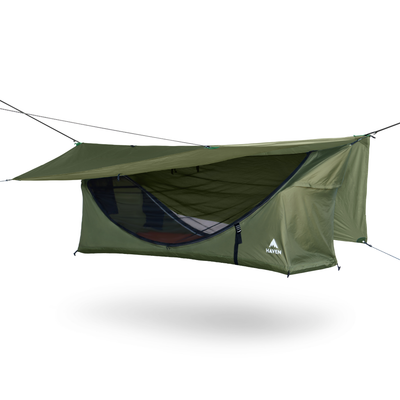
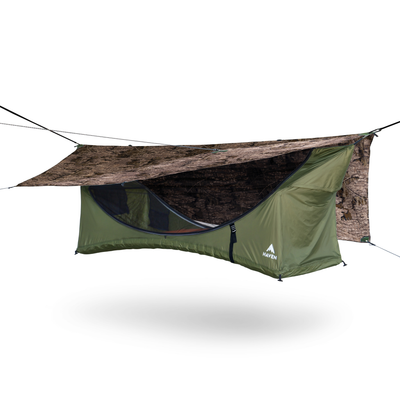
Haven's lay-flat sleep systems combine the two: a suspended, flat platform with an insulated pad (R2.5-R5.3), a built-in bug net and a rainfly, so you can sleep on your back, side or stomach. The trade-offs: you need two anchor points (trees, a stand or a hitch mount) or you pitch it on the ground in bivy mode, each Haven sleeps one person, and ultralight 1-person ground shelters can weigh less. See how Haven compares with ground tents.
The basics
What is an outdoor sleep system?
In one sentence
An outdoor sleep system is everything you use to sleep outside, working together: a shelter from rain, wind and bugs, something that supports you, insulation underneath you, and a sleeping bag or quilt on top.
If you're shopping for a new camping tent and care most about how you actually sleep, an outdoor sleep system is usually a better choice than a traditional ground tent.
Complete sleep solution in one package
An outdoor sleep system is the full setup you use to actually sleep outside—shelter, support, and comfort.
Most campers piece this together with a camping tent, a sleeping pad, and add-on accessories. Haven combines all three into one elevated, flat-lay tent system that replaces your tent and pad.
Three systems in one
01
Shelter
Fully enclosed bug net and rainfly like a tent
02
Structure
Tensioned bed surface that stays flat and supported
03
Comfort
Insulated pad that locks into place so it doesn't slide or pop
Want to see how this compares side by side with a traditional tent and pad?
Every way of sleeping outside combines the same four parts in a different package: shelter from rain, wind and bugs, support under your body, insulation under you, and a sleeping bag or quilt on top. Here is how the common setups compare.
System
What it is
Suits
Trade-offs
Tent + sleeping pad
A ground tent for shelter and a separate pad for cushioning and insulation.
Most campers. Shared space for two or more, and any flat site you can stake.
Comfort and warmth depend on the pad (its thickness and R-value) and the ground under it. Side sleepers often feel it at the hips and shoulders.
Tent cot (cot tent)
A small tent built onto a folding cot frame, so you sleep on a raised bed inside your shelter.
Car camping on level sites, keeping off mud, damp ground and crawling bugs, and people who find it hard to get up from the ground.
Heavy and bulky to carry far, still needs a level spot, and air moving under the cot takes heat away, so most people add a pad.
Cot inside a tent
A separate camp cot set up inside a large tent.
Base camps and family car camping with a tall tent.
Needs a big tent with floor space, two products to carry and set up, and a pad on the cot when it is cold.
Swag or bivy
A swag is a canvas bedroll with a built-in mattress; a bivy is a minimal waterproof sack over your bag. Both sit on the ground.
Swags: quick setup on vehicle trips. Bivies: the lowest weight and smallest pack.
You are on the ground, with little room to sit up or store gear. Swags are heavy; bivies can collect condensation.
Rooftop tent
A tent that folds out on a vehicle's roof rack, with a mattress inside and a ladder to climb in.
Overlanders and couples who camp from the vehicle and want a shared bed off the ground.
Needs a vehicle and rack, has to be packed up before you can drive anywhere, and the ladder isn't for everyone at night.
Gathered-end hammock + tarp and underquilt
Fabric gathered at each end, with a separate tarp, bug net and underquilt (or pad) for the night.
Back sleepers and loungers who want the lightest, lowest-cost hang where there are trees.
You sleep in a curve (lying diagonally helps). Side and stomach sleeping is hard for most people, and each part is bought and set up separately.
Bridge hammock
A hammock held open by spreader bars at the head and foot, so you lie straight along it. Tarp and insulation are added separately.
Backpackers who want a flatter hang than a gathered-end hammock at a low weight.
Flatter, not flat: the fabric still dips toward the middle. A rainfly and insulation are usually extra.
Lay-flat hammock tent (Haven)
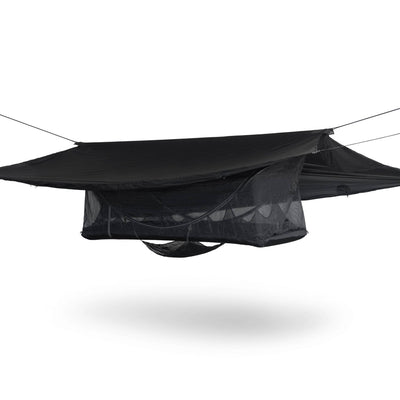
A suspended, flat platform with the pad held in the frame, a built-in bug net and a rainfly.
Side and stomach sleepers, and rocky, sloped or uneven sites with trees or a stand.
Needs two anchor points or a stand (or pitches on the ground as a bivy). Each one sleeps one person, with less room to sit out a long storm, and it is heavier and bulkier than a bridge or gathered-end hammock.
There is no single best sleep system. Start from how you camp and what keeps you awake, then pick the setup that solves that problem. Highlighted rows are where we'd point you to a Haven.
Your situation
Usually the best fit
Why
Also consider
You sleep on your side or stomach and camp where there are trees
Lay-flat hammock tent
A flat, evenly supported bed off the ground with the insulated pad held in place, so you can sleep in your normal position.
A thick pad in a ground tent, if you rarely have anything to hang from.
You backpack and the lowest pack weight comes first
Ultralight tent or tarp with a pad, or a bridge hammock
The lightest and smallest-packing ways to sleep out.
The Haven Spectre, Haven's lightest kit, if sleeping flat matters more to you than the lowest weight. Compare kit weights on its product page.
You backpack but sleep badly on the ground
Lay-flat hammock tent (Haven Spectre)
Shelter, flat bed and insulation in one kit, off rocks and roots. Above treeline it pitches on the ground in bivy mode with trekking poles.
A bridge hammock with your own tarp and insulation, for a lighter, modular setup.
You car camp solo or as a couple, with trees
One lay-flat hammock tent each (Haven XL or Haven Safari)
Each person gets a flat, insulated bed off the ground, with no roof rack or cot frame to haul.
A large tent with cots or thick mattresses if you want to share a bed.
You camp as a family in one shelter, or want to share a bed
Large tent with thick pads, air beds or cots
Shared space, room for a big mattress or cots, and room to sit out bad weather together.
A Haven for anyone in the group who sleeps badly on the ground (one person per Haven).
Your sites are muddy, rocky, sloped or full of roots
Lay-flat hammock tent, or a tent cot on level ground
Both lift you off the mess. A hammock tent doesn't need level ground; a cot does.
A ground tent only where you can find a clear, flat, well-drained patch.
You find it hard to get up from the ground
Cot or tent cot with a pad
The easiest bed to get in and out of: sit on the edge and swing your legs up.
A low-hung Haven: you sit on the low side wall and lie back.
You car camp where there are no trees
Tent cot, rooftop tent, or a Haven on a stand or hitch mount
Each gives you a bed off the ground without trees. The Haven Stand (17.1 lb) and hitch mounts are car-camping gear.
A ground tent with a thick pad if you'd rather not bring a frame.
You camp above treeline, in deserts or on open beaches
Ground tent with a good pad
There is often nothing to hang from, so a ground tent is the simplest choice.
A Haven in bivy mode on the ground if you already own one, or on the Haven Stand where you can drive in.
You camp in cold weather
Any shelter that suits the trip, with plenty of insulation under you
Cold usually comes from below: a high R-value pad on the ground, an underquilt in a regular hammock, or a Haven's insulated pad plus the Insulated Pad Cover.
A warmer bag on its own won't fix a cold back; the layer under you does that job.
Every Haven sleeps one person. Haven Tent: 24 x 78 in platform, best for campers under about 180 lb. Haven XL, Spectre and Safari: 30 x 80 in. Rated to 285 lb (Safari 350 lb). Help choosing: Haven Tent or Haven XL?
Tent cot vs hammock tent
Tent + pad vs tent cot vs lay-flat hammock tent
Looking for a tent cot, a cot tent or a tent with a bed built in? There are two main ways to get a shelter and a raised bed in one product: a tent cot, which stands on legs, and a lay-flat hammock tent, which hangs. Both keep you off mud, rocks, roots, damp ground and crawling insects. Here they are next to the usual tent and pad.
Compare
Tent + pad
Tent cot
Lay-flat hammock tent (Haven)
What you sleep on
A pad on the ground
A tensioned cot bed, usually with a pad on top
An insulated air pad held flat in a suspended frame
Off the ground?
No
Yes, on the cot's legs (camp cots typically sit about 7-19 in up)
Yes, hung low from two anchor points
Insulation underneath
From the pad: check its R-value
Air moves under the cot, so add a pad on cool nights
Built in: insulated pad, R2.5-R5.3 by model; add the Insulated Pad Cover for cold nights
Bugs and rain
Tent body and rainfly
Tent body and rainfly on the frame
Built-in bug net and rainfly
Where it sets up
Any flat, clear patch you can stake
Level ground; no trees needed
Two trees about 12-15 ft apart, the Haven Stand or a hitch mount; on the ground in bivy mode as a fallback
People per bed
One or more, depending on the tent
Mostly one; some double versions
One person per Haven
Carry weight and bulk
Wide range, from ultralight to car camping
Heavier and bulkier than most tents because of the frame; best where you can drive to camp
One bag; heavier than a bare hammock. Kit weights are on each product page
Getting in and out
Down to the ground and back up
Easiest: sit on the edge like a bed
Sit on the low side wall and lie back
Best for
Groups, open treeless sites, the lowest weight
Level car-camping sites, and people who find the ground hard to get up from
Side and stomach sleepers on rough or sloped sites with trees, car camping or backpacking
Gain a flat, bed-like surface off roots and rocks, with setup in about 5 minutes once you've practiced. Each Haven sleeps one person, so a family hangs one each, side by side.
Gain a flat bed off the ground for side sleeping, with the pad held in place. The Spectre is Haven's lightest kit (weights for every configuration are on its product page); ultralight 1-person shelters can be lighter. It can also pitch on the ground as a bivy when there are no trees.
If you've ever searched "why can't I sleep in a tent" or "best tent for side sleepers," these are the outdoor sleep problems Haven was designed around:
Each system is designed to replace your tent and sleeping pad
Outdoor Sleep System
Haven Tent
The original lay-flat sleep system: lighter and more compact than the XL, and a good fit for average builds. Replaces a traditional tent + sleeping pad with a flat, supportive bed surface.
Wider (30 x 80 in) elevated sleep system for bigger frames and taller campers, up to about 6'6" lying stretched out. Replaces a tent + sleeping pad for car camping or backpacking.
Ultralight elevated sleep system for backpackers who want to sleep flat on the trail: Haven's lightest kit, on the XL's 30 x 80 in platform. Replaces a backpacking tent + sleeping pad. Kit weights for every configuration are on the product page.
Heavy-duty elevated sleep system for overlanding, extended trips, and larger bodies. Built for durability and long-term comfort. Replaces heavy-duty tents and rooftop tents.
A full kit is the shelter and the bed in one box. These are the contents listed on each product page.
Included
Haven Tent
Haven XL
Haven Spectre
Haven Safari
Hammock body with bug net
Included
Included
Included
Included
Rainfly
Included
Included
Dyneema or Silpoly
Included
Insulated air mattress with pump bag
Included
Included
Included
Included
Spreader bars (2x)
Aluminum
Aluminum
Carbon fiber
Aluminum
Tree straps (2x)
6 ft / 182 cm
6 ft / 182 cm
12 ft / 366 cm
6 ft / 182 cm
Carabiners (2x)
Included
Included
Ultralight
Included
Guy lines (4x) and stakes (4x)
Included
Included
Included
Included
Gear sling
Included
Included
Included
—
“No Rainfly” and “No Pad” kits leave that item out; everything else is the same. Haven Seconds come with the same contents as new. Full checklist: Hammock tent gear checklist.
What you still need
Each kit replaces your tent and sleeping pad. Bring your own bedding for the season.
Every trip
A sleeping bag or top quilt, which is not in the kit. Choose one rated for the lowest temperature you expect, and bring a pillow if you use one.
Summer
A lighter bag or quilt for warm nights. The kit's insulated pad stays under you either way.
Spring and fall
A bag or quilt rated for the night's low. Wind under a suspended bed takes heat away, which is what the insulated pad is there for.
Every Haven comes as a complete kit, ready to use out of the box. These categories offer additional gear to take your already incredibly comfortable setup even further.
Yes, for one person. Each Haven kit includes a hammock body with a built-in bug net, a waterproof rainfly and an insulated pad (unless you choose the no-pad option), so it replaces both your tent and your separate sleeping pad. Instead of a tent floor plus pad, you sleep on a flat, suspended platform. Bring your own sleeping bag or top quilt. See what comes in each kit, or read What Is an Outdoor Sleep System?
What else do I need to pack with a Haven?
Bedding (a sleeping bag or top quilt, and a pillow if you use one), plus whatever you would bring on any camping trip. Where there are no trees, add a stand or hitch mount, or use trekking poles to pitch in bivy mode. See the hammock tent gear checklist.
Which is better, a hammock tent or a ground tent?
It depends on how and where you camp. A ground tent makes more sense if you want shared space for several people, camp somewhere you know is treeless and don't want to carry a stand, expect to sit out long storms inside, or want the lightest possible 1-person shelter. A lay-flat system like Haven makes more sense if your priority is sleeping flat and off uneven ground, especially on your side. Read the full Haven vs ground tents comparison or our post Hammock Tent vs Ground Tent.
What is the best sleep system for camping?
There isn't one best system for everyone. Every sleep system does four jobs: shelter from rain, wind and bugs; support under your body; insulation under you; and a sleeping bag or quilt on top. The right mix depends on how you camp, the coldest night you expect, how you sleep and who you share with. For one person who sleeps on their side or stomach and camps where there are trees, we'd choose a lay-flat hammock tent such as the Haven XL. For a family in one shelter, a large tent with thick pads or cots. For the lightest pack, an ultralight tent or tarp with a pad. See which system fits your trip and every type compared.
What do experienced campers use for a sleep system?
Most think in layers rather than one product: a shelter (tent, tarp, hammock tent or vehicle); something to lie on (a closed-cell foam, self-inflating or air pad, a cot, or a hammock); insulation under them, which on the ground comes from the pad's R-value and in a hammock from an underquilt or insulated pad; a sleeping bag or top quilt rated for the night's low; and small comforts such as a pillow, dry sleep clothes, earplugs and an eye mask. Foam pads are light, cheap and can't puncture but are thin; self-inflating pads add cushioning; air pads are the thickest and pack smallest but need inflating and can puncture. Quilts are lighter and less confining than bags but can let in drafts if you move around a lot. A Haven combines the shelter, the bed and the insulation underneath in one kit; you add the bag or quilt and a pillow (what's in each kit).
Does the sleeping pad or the sleeping bag matter more for warmth?
Both matter, because they do different jobs. A sleeping bag keeps you warm by trapping air, and the part under you is crushed flat by your weight, so it does little against the cold ground or the air moving under a cot or hammock. That job falls to whatever is under you: a pad's R-value on the ground, or an underquilt or insulated pad when you sleep off the ground. A warmer bag can't make up for a thin pad, and a good pad can't make up for a bag that's too light for the night. So check both: enough insulation under you, and a bag or quilt rated for the coldest night you expect. More in Do You Need a Sleeping Pad If You Sleep Off the Ground?
What R-value do I need for each season?
R-value measures how well a pad resists heat flowing from you into the ground; higher is warmer, and pads tested to the ASTM F3340 standard can be compared directly. As a rough guide, summer pads are often below R2, three-season pads about R2-R4, and winter pads R4-R5 and up; if you sleep cold, go higher. Off the ground you still need insulation underneath, because moving air takes heat away. Haven's pads are R2.5 (Spectre pad, warm weather), R5 (Premium pad, Haven Tent) and R5.3 (True Level pads), which makes a Haven a 3-season system; the Insulated Pad Cover adds insulation for colder nights. Your bag or quilt, the wind and how well the rainfly is pitched matter too, so there's no single temperature rating. See How to Hammock Camp in the Cold.
All-in-one sleep system or tent and pad: which is better?
Neither is better for everyone. By all-in-one we mean anything that puts the shelter and the bed in one product: tent cots, swags and bivy kits, bag-and-pad systems, and lay-flat hammock tents like Haven. An all-in-one suits a solo camper who puts comfort first and wants one thing to pack and set up, especially off the ground. A separate tent and pad suits you if you want the lowest weight, share a shelter with a partner or family, camp where there's nothing to hang from, or like swapping parts (a warmer pad in winter, a lighter tent for a long hike). One-person integrated systems are a poor fit for couples who want to sleep together and for families who want one shelter. A Haven is modular in one way: you can order it without the pad or the rainfly, and pads and rainflies are sold separately, so you can change them later. Choose by trip and sleep style.
Tent cot or lay-flat hammock tent: which should I get?
Both give you a shelter and a raised bed in one product (people also search for a cot tent or a tent with a bed). A tent cot stands on legs, so it needs level ground but no trees; it's the easiest bed to get in and out of, and it's heavy, so it suits drive-in camping. A lay-flat hammock tent hangs from two trees or a stand, so slope, rocks, roots and mud don't matter; it packs into one bag for car camping or backpacking, and the insulated pad is built in. Air moving under a cot takes heat away, so most people add a pad on cool nights. Choose a tent cot for level, treeless car-camping sites or if getting up from the ground is hard. Choose a lay-flat hammock tent if you sleep on your side or stomach, camp on rough wooded sites, or want to carry it. See them side by side.
Can one product replace a tent, sleeping pad and cot?
Mostly, yes, in two ways. A tent cot replaces the tent and the cot, but most people still add a pad for warmth. A lay-flat hammock tent like a Haven replaces the tent and the pad, and does the cot's job differently: instead of legs, the flat bed hangs from two trees or a stand, with the insulated pad built in. That works if you camp solo (each Haven sleeps one), usually have trees or bring a stand, and want one kit. It doesn't if you share a bed, camp mostly on open ground and won't carry a stand, or want room to sit out long storms; then keep the tent and pad, or choose a tent cot for drive-in sites. More in Hammock vs Cot vs Sleeping Pad.
Will an outdoor sleep system help me sleep better than a tent?
Only if it fixes what keeps you awake. If it's hard, uneven or sloped ground, or sore hips and shoulders on a pad, a flat bed off the ground (a lay-flat hammock tent or a cot) deals with that directly. If you overheat, choose a shelter with plenty of mesh you can open up: in a Haven, guy out the rainfly or roll it back and sleep under the bug net. If first light wakes you, an eye mask works in any shelter, and so does pitching the door away from the sunrise. If condensation leaves you damp, keep a vent or the edge of the fly open. If you want room for a big air bed, a cot or a partner, or to sit out a long storm with others, a large tent is the better choice. Comfort is personal; if pain is what keeps you up, check with a doctor or physical therapist. See when a ground tent wins.
Is Haven good for side sleepers or people with back pain?
Haven was designed with side sleepers in mind. The platform lies flat instead of curving like a gathered-end hammock, and the insulated pad is shaped to the frame so it stays centered. Compared with a pad on the ground, that flat, evenly supported surface reduces pressure on hips and shoulders, and many owners tell us they wake up less sore. We can't promise it will help a medical condition, and comfort is personal, so check our returns policy before you buy. On size: the Haven XL is wider (30 in vs 24 in) for bigger frames, while average builds often prefer the original Haven Tent (how to choose). More in Hammocking for Side Sleepers and Camping With Back or Joint Pain.
Do I still need a sleeping pad if I sleep off the ground?
Usually, yes. Air moving under a cot or hammock takes heat away, and a sleeping bag flattens under your weight, so it insulates little beneath you. That is why every Haven kit includes an insulated pad held in the frame, unless you choose the no-pad option. More in Do You Need a Sleeping Pad If You Sleep Off the Ground?
Is Haven a good choice for car camping?
Yes. When you drive to camp, weight matters less, so you can choose for comfort and durability. The Haven Safari uses heavy-duty 300d polyester and is rated to 350 lb (158 kg); the Haven Tent and Haven XL are lighter options that also work for backpacking. Where there are no trees, use the Haven Stand or a hitch mount from Stands and Mounts. Each Haven sleeps one person, so families and groups hang one each, side by side.
What's a good sleep system for backpacking?
If you want to sleep flat on the trail, look at the Haven Spectre: Haven's lightest kit, on the Haven XL's 30 x 80 in platform, with the R2.5 Spectre pad and a Dyneema or Silpoly rainfly. Kit weights for every configuration are on its product page, so compare them with your current tent and pad. If the lowest weight matters most, an ultralight 1-person tent or tarp with a pad, or a bridge hammock with your own tarp and insulation, will be lighter. The Spectre's mesh hammock body isn't waterproof (the rainfly does that job), and above treeline you pitch it on the ground in bivy mode with trekking poles. The Haven Tent and XL also work for backpacking if you accept more weight; see Haven Tent for Backpacking.
Does Haven keep bugs out?
Every Haven has a built-in bug net that zips closed, and sleeping off the ground keeps you away from most crawling insects. You can run the net fully closed, partly open for airflow, or stowed in the end pocket when bugs aren't an issue. Small holes can be fixed with Bug Net Patches. See the bug net guide.
What are the alternatives to sleeping on a pad on the ground?
The main way to change how you sleep is to get off the ground: camp cots, traditional hammocks with an underquilt, bridge hammocks, and lay-flat sleep systems like Haven. Haven doesn't do away with the pad: its insulated pad (R2.5-R5.3) is part of the structure, but it's held flat in a suspended frame instead of lying on rocks and roots, and it stays centered rather than sliding around. On cold nights, add the Insulated Pad Cover for more insulation under your core.
How is a lay-flat hammock different from a regular hammock?
A regular gathered-end hammock curves, which suits lounging and back sleeping, and it is lighter and cheaper. A lay-flat hammock tent holds a flat platform with a pad in a frame, so you can sleep on your side or stomach, and it adds a bug net and rainfly. Read Lay-Flat vs Regular Hammock and Are Lay-Flat Hammocks Worth It? for the pros and cons.
Can I use Haven anywhere I'd use a tent?
Almost anywhere. If you have two anchor points (trees, a vehicle roof rack, etc.) 12-15 feet apart, you can set up a Haven. For treeless areas, use our Stands and Mounts to create your own anchor points. In a pinch, you can pitch your Haven on the ground as a bivy without any suspension, and you still sleep on its insulated pad. Hammock rules vary by campground and park, so check before you go: see which national parks allow hammocks.
Is Haven good for beginners?
Yes, for many beginners it's simpler than buying a tent and a pad separately, because everything comes in one kit: wrap the tree straps, clip in the suspension, insert the spreader bars and pad. It takes about 5 minutes once you've practiced; your first setup takes longer, so try it at home first. Our setup guides have a video for each step, from hang angle to the rainfly. New to camping in general? Start with Camping for Beginners.
Is this a hammock or a tent?
It's neither—it's an outdoor sleep system. Haven combines the comfort and view of a hammock with the flat sleeping position and weather protection of a tent. Think of it as a suspended tent with a bed inside.
Can I use Haven without trees?
Yes. Use our Stands and Mounts to set up your Haven anywhere: beaches, deserts, parking lots, or your backyard. The stands create stable anchor points just like trees would. The Haven Stand weighs 17.1 lb (7.75 kg), so it suits car camping best. And if you find yourself without trees or stands, your Haven can work as a ground bivy, still on its insulated pad.
What if I already own a tent?
Keep it. Many Haven owners keep a tent for group trips, treeless sites and long storms, and use their Haven when they're camping solo and want to sleep flat. You're not abandoning your tent; you're adding a better bed for the trips where it fits.
What seasons can I use Haven sleep systems?
Haven sleep systems are 3-season with the insulated pad; add the Insulated Pad Cover for 4-season use. Pair it with a top quilt or sleeping bag rated for your conditions. More in How to hammock camp in the cold.