Hammock Tents vs Regular Tents: Which Keeps Bugs Out Better?
Haven Tents · October 21, 2026 · 3 min read

Which keeps bugs out better, a hammock tent or a regular tent? Both work well when they're zipped shut. A ground tent seals you in with a floor and mesh walls; a hammock tent with a built-in bug net, like a Haven, does the same while also keeping you off the ground, away from ants, spiders and other crawling insects. The weak points differ: a tent lets bugs in through the door and any gap at the floor, while a plain hammock with a separate net lets mosquitoes bite through the fabric under you. A hammock tent with an insulated pad between you and the fabric avoids that. Either way, ticks and mosquitoes are a reason to use repellent and check yourself, not just to trust the shelter.
How each shelter keeps bugs out
Regular ground tents
The inner tent's mesh panels and the sewn-in floor make a closed box. Good tents use fine mesh that stops small biting insects as well as mosquitoes. Bugs get in when the door is open, through a damaged zipper or mesh, or by following you in with your gear. Because you're on the ground, anything crawling around your site will find the tent walls first.
Traditional hammocks
A gathered-end hammock on its own has no protection. Campers add a separate bug net that zips around the hammock or hangs from a ridgeline. The common problem is underneath: mosquitoes can bite through a single layer of hammock fabric, so you need a pad or underquilt there too.
Lay-flat hammock tents
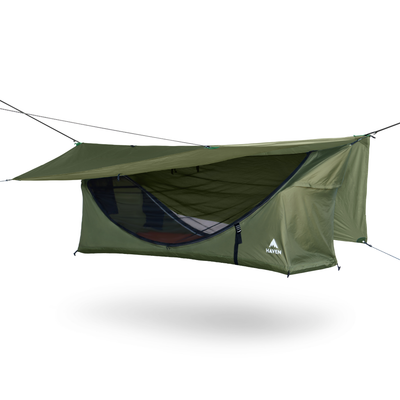
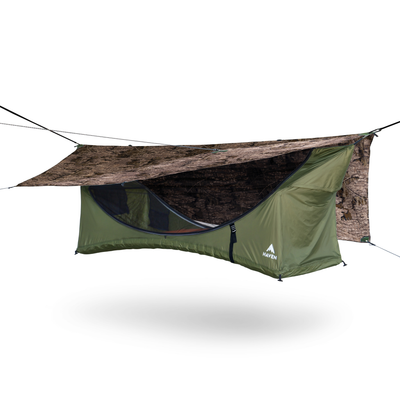
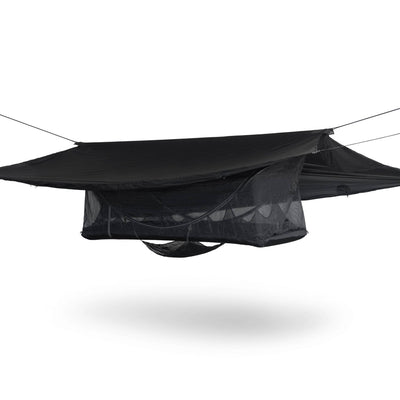
A Haven has a no-see-um bug net built into the hammock body and zipped shut, so there's nothing to rig. You're off the ground, away from crawling insects, and the insulated air mattress sits between you and the hammock fabric, so mosquitoes can't bite through from below.
Bug protection compared
| Ground tent | Hammock + separate net | Lay-flat hammock tent |
|---|
| Flying insects | Mesh walls | Separate net | Built-in no-see-um net |
| Crawling insects | Floor keeps most out; they can reach the walls | Off the ground | Off the ground |
| Bites through the fabric under you | Not an issue with a floor and pad | Possible without a pad or underquilt | Pad sits between you and the fabric |
| Setup to be bug-proof | Pitch and zip | Rig the net correctly | Zip the net |
| Typical weak point | Open door, gaps at the floor | Gaps where the net meets the hammock | Leaving the net open while you get in |
Bug-proofing tips for any shelter
- Get in fast and zip immediately. Most bugs inside a shelter came in with you.
- Set up away from standing water and dense, damp undergrowth where mosquitoes and ticks gather.
- Keep food and scented items out of your shelter, which also matters for bear safety.
- Use repellent as directed on the label, and check for ticks every evening, wherever you sleep.
- Inspect mesh and zippers before the season and repair small holes early.
- In a hammock, remember the straps. Insects can crawl along the suspension; keep the net closed rather than relying on height alone.
Which should you choose?
If you sleep in a group or your sites have no trees, a well-made ground tent keeps bugs out just fine. If you camp in wooded, buggy places and want to stay off the ground, a lay-flat hammock tent gives you net, insulation and rain cover in one kit without a separate net to rig. Each Haven sleeps one person and needs two trees, a stand or a hitch mount; on the ground in bivy mode the net still closes, but you lose the height advantage.
Warm nights are usually the buggiest, so see Do Hammock Tents Keep You Cooler in Hot Weather? too. For other differences, read Hammock Tent vs Ground Tent, Haven vs Ground Tents and our outdoor sleep systems page, or compare models in the hammock tents collection.
← Back to Adventure Journal
<div class="dynamic-checkout__content" id="dynamic-checkout-cart" data-shopify="dynamic-checkout-cart"> <shopify-accelerated-checkout-cart wallet-configs="[{"supports_subs":true,"supports_def_opts":false,"name":"shop_pay","wallet_params":{"shopId":11057397823,"merchantName":"Haven Tents","personalized":true}},{"supports_subs":true,"supports_def_opts":false,"name":"paypal","wallet_params":{"shopId":11057397823,"countryCode":"US","merchantName":"Haven Tents","phoneRequired":true,"companyRequired":false,"shippingType":"shipping","shopifyPaymentsEnabled":true,"hasManagedSellingPlanState":false,"requiresBillingAgreement":true,"gatewayType":"CONNECTED","merchantId":"AT9YPQVBATPVS","sdkUrl":"https://www.paypal.com/sdk/js?components=buttons\u0026commit=false\u0026currency=USD\u0026locale=de_DE\u0026client-id=AexZEtAxk09Ncgj6FSWFFyGKbxxAZ_LTyJ2DPdJWl1YUlecinmc5AfIaRF2qYjWlusWahlzz6SVkY5Ci\u0026merchant-id=AT9YPQVBATPVS\u0026intent=authorize","serviceableCountryCodes":["AC","AD","AE","AF","AG","AI","AL","AM","AO","AR","AT","AU","AW","AX","AZ","BA","BB","BD","BE","BF","BG","BH","BI","BJ","BL","BM","BN","BO","BQ","BR","BS","BT","BW","BY","BZ","CA","CC","CD","CF","CG","CH","CI","CK","CL","CM","CN","CO","CR","CV","CW","CX","CY","CZ","DE","DJ","DK","DM","DO","DZ","EC","EE","EG","EH","ER","ES","ET","FI","FJ","FK","FO","FR","GA","GB","GD","GE","GF","GG","GH","GI","GL","GM","GN","GP","GQ","GR","GS","GT","GW","GY","HK","HN","HR","HT","HU","ID","IE","IL","IM","IN","IO","IQ","IS","IT","JE","JM","JO","JP","KE","KG","KH","KI","KM","KN","KR","KW","KY","KZ","LA","LB","LC","LI","LK","LR","LS","LT","LU","LV","LY","MA","MC","MD","ME","MF","MG","MK","ML","MM","MN","MO","MQ","MR","MS","MT","MU","MV","MW","MX","MY","MZ","NA","NC","NE","NF","NG","NI","NL","NO","NP","NR","NU","NZ","OM","PA","PE","PF","PG","PH","PK","PL","PM","PN","PS","PT","PY","QA","RE","RO","RS","RU","RW","SA","SB","SC","SD","SE","SG","SH","SI","SJ","SK","SL","SM","SN","SO","SR","SS","ST","SV","SX","SZ","TA","TC","TD","TF","TG","TH","TJ","TK","TL","TM","TN","TO","TR","TT","TV","TW","TZ","UA","UG","UM","US","UY","UZ","VA","VC","VE","VG","VN","VU","WF","WS","XK","YE","YT","ZA","ZM","ZW"]}}]" access-token="20cee07b2f5277b40ccae45e245d3c77" buyer-country="US" buyer-locale="de" buyer-currency="USD" shop-id="11057397823" cart-id="2cdf9cffa26e5c2eb2e5c0dc7bc576dd" enabled-flags="["a1d1f9a1","f5afabb3","370070f3","b311f899"]" > <div class="wallet-button-wrapper"> <ul class='wallet-cart-grid wallet-cart-grid--skeleton' role="list" data-shopify-buttoncontainer="true"> <li data-testid='grid-cell' class='wallet-cart-button-container'><div class='wallet-cart-button wallet-cart-button__skeleton' role='button' disabled aria-hidden='true'> </div></li><li data-testid='grid-cell' class='wallet-cart-button-container'><div class='wallet-cart-button wallet-cart-button__skeleton' role='button' disabled aria-hidden='true'> </div></li> </ul> </div> </shopify-accelerated-checkout-cart> </div>



Comments (0)
No comments yet — be the first!
Leave a Comment