How to Set Up a Camping Hammock
Haven Tents · February 5, 2024 · 4 min read

How do you set up a camping hammock? Find two healthy, living trees with no dead branches overhead, wrap a wide tree strap around each one, clip the hammock to the straps, and adjust until the straps sit at roughly a 30-degree angle from horizontal (for a Haven, anywhere from 15 to 30 degrees). Keep it low, sit in it to test before you lie down, then add your rainfly and bug net. The steps below cover a traditional hammock, then how setup differs with an all-in-one lay-flat hammock tent like the Haven.
How to set up a traditional camping hammock
- Pick your trees. Look for two healthy, living trees, roughly 12 to 15 feet apart depending on your hammock's length. Look up before you commit: dead branches overhead are a hazard. Avoid spots near the campfire, where wind can carry sparks.
- Wrap the straps. Use wide tree straps, not thin rope, to protect the bark. Wrap one around each tree at a height that gives you the right hang angle (step 4).
- Attach the hammock. Clip the hammock to the straps with carabiners, or use the knots or buckles your system is designed for.
- Set the hang angle. For a gathered-end hammock, aim for straps about 30 degrees from horizontal. Too tight puts a lot of extra load on the straps and trees and makes the hammock tippy; too loose and you sag deeply. A hang calculator helps.
- Keep it low. Hang the hammock about as high as a chair seat when you're in it, so a fall is never a long one.
- Test it. Sit in the middle first, then lie back. Adjust the straps until it feels right. In a gathered-end hammock, lie slightly diagonally to flatten out.
- Add weather and bug protection. Pitch a tarp over the ridgeline and stake out its corners, and add a bug net if you need one.
- Add drip lines if rain is expected. A short cord tied to each strap lets water drip off before it runs down the strap into your hammock.
- Insulate underneath. On cool nights you need an underquilt or a pad below you; a sleeping bag alone gets compressed under your weight.
Setting up a Haven
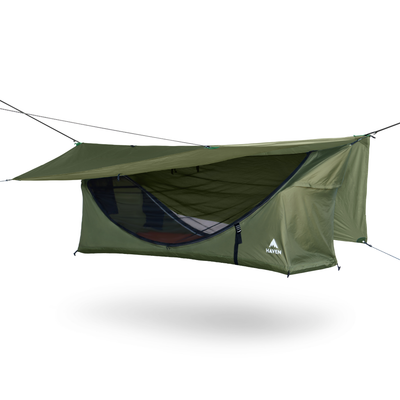
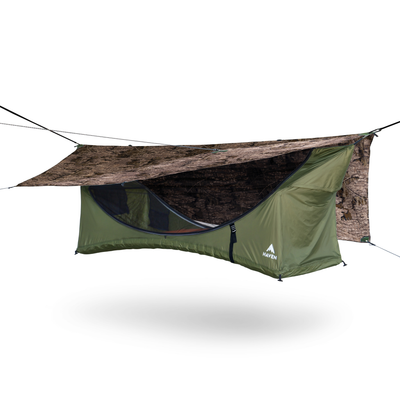
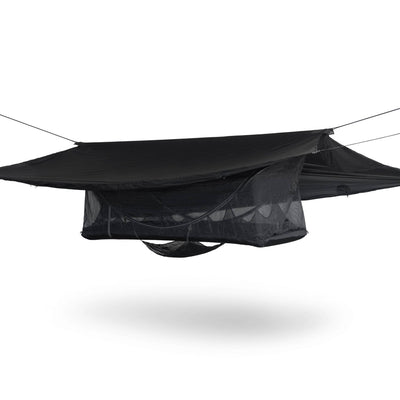
A traditional setup has a learning curve and a lot of separate pieces: hammock, tarp, bug net, underquilt and suspension. A Haven puts them in one kit. The rainfly and bug net are built in, the insulated pad replaces the underquilt, and the structural ridgeline holds the same shape whatever the tree spacing.

- Wrap the tree straps around two healthy trees and clip in the carabiners (setup guide videos).
- Set the hang angle between 15 and 30 degrees (hang angle), and keep it low (hang safe).
- Insert the spreader bars into the four pockets at the head and foot ends. Don't put them under the pad (spreader bars).
- Inflate the pad and slide it in. It's part of the structure and your bottom insulation (Insulated Pad).
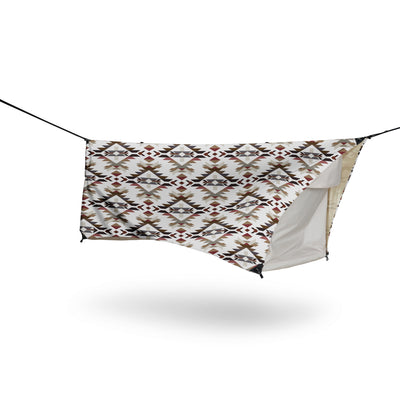
- Secure the rainfly to the ridgeline, or batten it down if weather is coming (rainfly).
What comes in a Haven kit
Each Haven kit includes the hammock body with a built-in bug net, pockets and structural ridgeline; two spreader bars; an insulated air mattress with a pump sack (unless you choose "no pad"); a rainfly; two tree straps and two carabiners; and four guylines and stakes. Haven Tent and Haven XL kits also include a gear sling. The insulated pad doubles as your bottom insulation, so you don't need an underquilt. Exact contents and weights for each model are on its product page and in the What's in the box chapter.
Things to know before you buy
- Each Haven is a one-person tent (285 lb for the Haven Tent, XL and Spectre; 350 lb for the Safari). Pairs hang two side by side.
- You need two anchor points (trees, a stand or a hitch mount), or you pitch it on the ground in bivy mode.
- It's heavier than a bare hammock, because the pad, rainfly and bug net are included.
It takes about 5 minutes once you've practiced, so do your first setup at home. No trees? Use a stand, or pitch it on the ground as a bivy tent.
Look after your straps
Keep tree straps away from moisture and sharp objects, in use and in storage, and check them for tears or tree sap before each trip. Damaged webbing is weaker, one more reason to hang low.
Why the lay-flat difference matters
Because a Haven holds its pad flat, you can sleep on your back, side or stomach without lying diagonally. Check you have everything with our hammock tent gear checklist, compare the models in our hammock tents collection, or read how a Haven compares with a tent and pad in Haven vs Ground Tents.
← Back to Adventure Journal
<div class="dynamic-checkout__content" id="dynamic-checkout-cart" data-shopify="dynamic-checkout-cart"> <shopify-accelerated-checkout-cart wallet-configs="[{"supports_subs":true,"supports_def_opts":false,"name":"shop_pay","wallet_params":{"shopId":11057397823,"merchantName":"Haven Tents","personalized":true}},{"supports_subs":true,"supports_def_opts":false,"name":"paypal","wallet_params":{"shopId":11057397823,"countryCode":"US","merchantName":"Haven Tents","phoneRequired":true,"companyRequired":false,"shippingType":"shipping","shopifyPaymentsEnabled":true,"hasManagedSellingPlanState":false,"requiresBillingAgreement":true,"gatewayType":"CONNECTED","merchantId":"AT9YPQVBATPVS","sdkUrl":"https://www.paypal.com/sdk/js?components=buttons\u0026commit=false\u0026currency=USD\u0026locale=de_DE\u0026client-id=AexZEtAxk09Ncgj6FSWFFyGKbxxAZ_LTyJ2DPdJWl1YUlecinmc5AfIaRF2qYjWlusWahlzz6SVkY5Ci\u0026merchant-id=AT9YPQVBATPVS\u0026intent=authorize","serviceableCountryCodes":["AC","AD","AE","AF","AG","AI","AL","AM","AO","AR","AT","AU","AW","AX","AZ","BA","BB","BD","BE","BF","BG","BH","BI","BJ","BL","BM","BN","BO","BQ","BR","BS","BT","BW","BY","BZ","CA","CC","CD","CF","CG","CH","CI","CK","CL","CM","CN","CO","CR","CV","CW","CX","CY","CZ","DE","DJ","DK","DM","DO","DZ","EC","EE","EG","EH","ER","ES","ET","FI","FJ","FK","FO","FR","GA","GB","GD","GE","GF","GG","GH","GI","GL","GM","GN","GP","GQ","GR","GS","GT","GW","GY","HK","HN","HR","HT","HU","ID","IE","IL","IM","IN","IO","IQ","IS","IT","JE","JM","JO","JP","KE","KG","KH","KI","KM","KN","KR","KW","KY","KZ","LA","LB","LC","LI","LK","LR","LS","LT","LU","LV","LY","MA","MC","MD","ME","MF","MG","MK","ML","MM","MN","MO","MQ","MR","MS","MT","MU","MV","MW","MX","MY","MZ","NA","NC","NE","NF","NG","NI","NL","NO","NP","NR","NU","NZ","OM","PA","PE","PF","PG","PH","PK","PL","PM","PN","PS","PT","PY","QA","RE","RO","RS","RU","RW","SA","SB","SC","SD","SE","SG","SH","SI","SJ","SK","SL","SM","SN","SO","SR","SS","ST","SV","SX","SZ","TA","TC","TD","TF","TG","TH","TJ","TK","TL","TM","TN","TO","TR","TT","TV","TW","TZ","UA","UG","UM","US","UY","UZ","VA","VC","VE","VG","VN","VU","WF","WS","XK","YE","YT","ZA","ZM","ZW"]}}]" access-token="20cee07b2f5277b40ccae45e245d3c77" buyer-country="US" buyer-locale="de" buyer-currency="USD" shop-id="11057397823" cart-id="8fe0c8e86bffcc7db35f0de40354b469" enabled-flags="["a1d1f9a1","f5afabb3","370070f3","b311f899"]" > <div class="wallet-button-wrapper"> <ul class='wallet-cart-grid wallet-cart-grid--skeleton' role="list" data-shopify-buttoncontainer="true"> <li data-testid='grid-cell' class='wallet-cart-button-container'><div class='wallet-cart-button wallet-cart-button__skeleton' role='button' disabled aria-hidden='true'> </div></li><li data-testid='grid-cell' class='wallet-cart-button-container'><div class='wallet-cart-button wallet-cart-button__skeleton' role='button' disabled aria-hidden='true'> </div></li> </ul> </div> </shopify-accelerated-checkout-cart> </div>



Comments (0)
No comments yet — be the first!
Leave a Comment