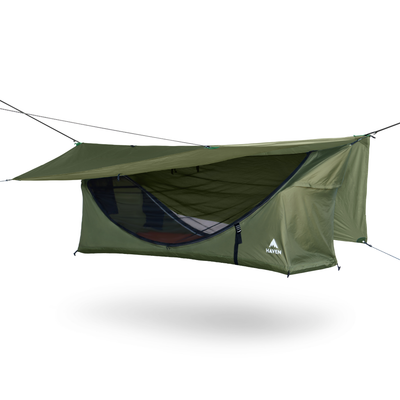
What makes a hammock stable? Stability comes from having the anchor points high above where you lie: the bigger that height difference, the harder the hammock is to tip. In a traditional hammock, that same geometry bends you into a banana, and pulling the suspension tight to flatten it makes the hammock tippy again. A lay-flat design like the Haven fixes the anchor points high above a separate, flat sleeping platform that hangs from arcs along the sides, so you get stability and a flat bed at the same time.
As a kid, nothing was better than playing in a tippy hammock. I remember pushing cousins to extreme heights trying to tip each other over... and usually succeeding.
Now, as a fragile adult, my hammock goals are different. The perfect hammock should be:
Stable
Comfortable and flat-laying
Easy to get in and out of
If those are your goals too, read on. I'll cover where traditional hammocks go wrong and what you need in your dream hammock. I even made a video (with help from my kids) to show where camping hammocks go wrong.
Why traditional hammocks are either stable or flat
As a rule of thumb, stability in a hammock comes from having the anchor points high above the sleeping platform. The bigger the difference between where you lie and where you're attached to the tree, the more stable the hammock.
Unfortunately, putting the anchor points that high has a cost. Yes, you gain stability, but now you're folded like a banana! To get the hammock to lie flatter, most hammockers pull the suspension tight.
With tighter suspension the banana sag is reduced, but the hammock becomes unstable. It's tricky to get in, and just when you start to relax... flip! You're on the ground. Great for kids, not so much for adults!
How the Haven gets both
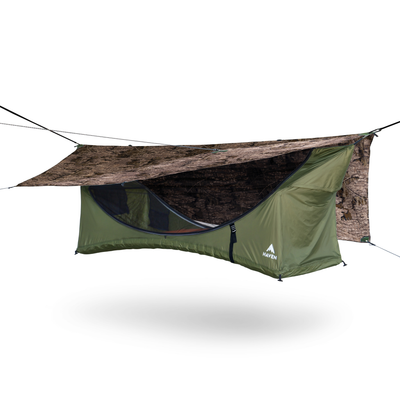
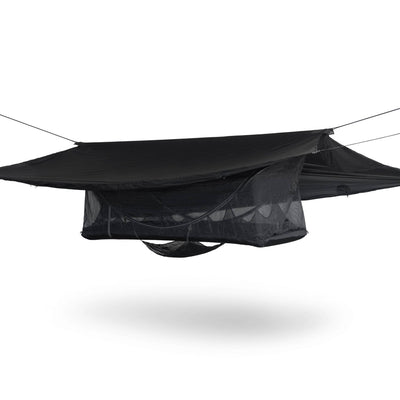
Hammocks are an amazing idea. In practice, traditional hammocks often fall short. At Haven Tents we've done things differently. In our system, the anchor points are fixed high above the sleeping platform. The tension is carried by two arcs down the sides, which suspend the flat sleeping platform (marked in red). So you get stability and a flat sleeping platform. The full engineering story is in The Secret Design Behind the Haven Tent.
Getting in and out
That covers the first two goals, stability and comfort. But what about access? Another big complaint about hammocks is that they're hard to get in and out of.
Again, the suspension arcs of the Haven make getting in and out quick and intuitive. You simply sit and lie back. You can use the ridgeline (the strap running from end to end overhead) for support. Just don't sit or stand on the spreader bars; they hold the sides open but aren't built to carry your weight.
Asymmetric and bridge hammocks address some of the issues with traditional hammocks (we compare them in A Hammock for Stomach Sleepers). But I challenge anyone to find a hammock that's more stable, lies flatter and is easier to get in and out of than the Haven Tent.
Now time for adventure, Derek & Wren... from Haven Tents
🚨 Please do not attempt the super swing. Everything was tested beforehand, and there were a lot of smaller swings before we tried the super swing. Even then, please don't! 😅



Comments (0)
No comments yet — be the first!
Leave a Comment