
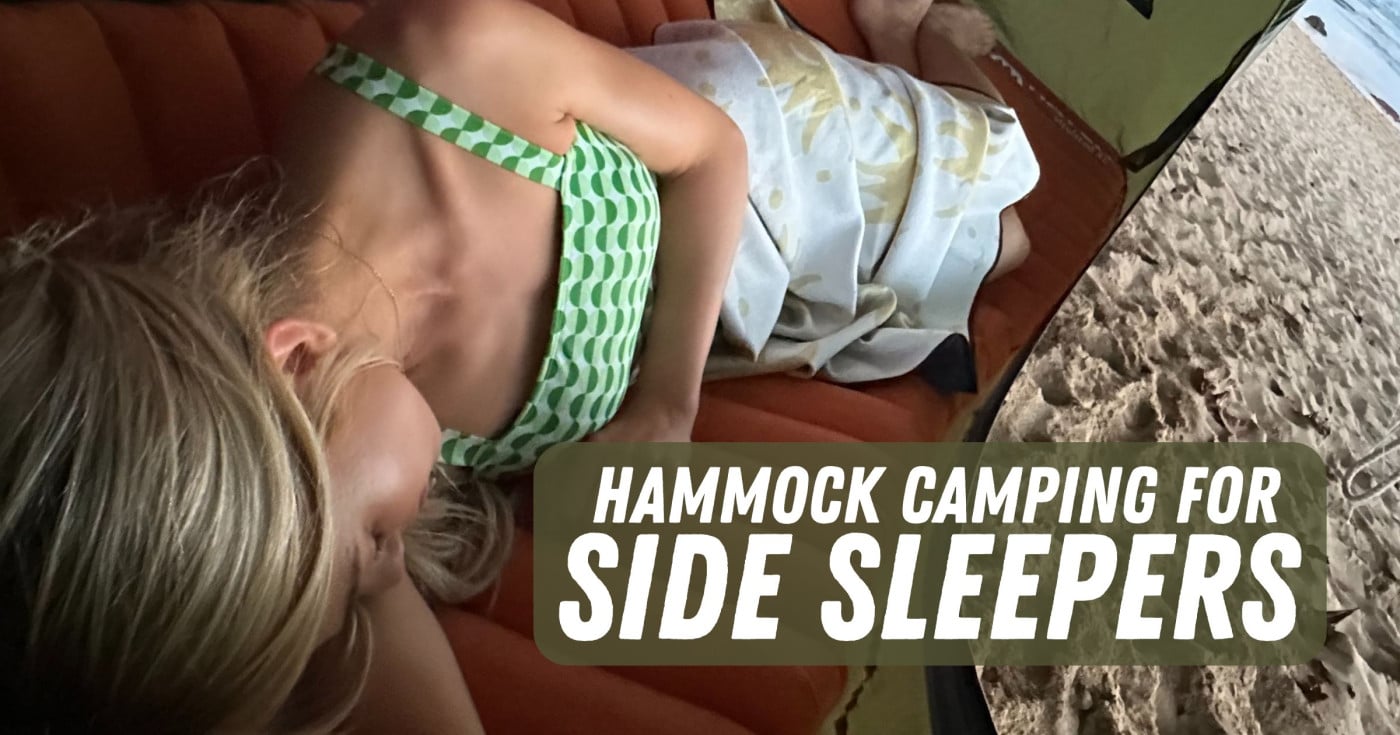
Can you sleep on your side in a hammock tent? Yes, if it's a lay-flat hammock tent. A lay-flat design such as the Haven holds an insulated pad flat in a suspended frame, so you can lie on your side much as you would on a bed and roll over without the sides closing in.
In a traditional gathered-end hammock most side sleepers struggle, because the hammock curves you into a banana shape and squeezes in at the shoulders. Bridge hammocks are flatter, and some side sleepers manage in them. Compared with a pad on the ground, a flat, evenly supported surface spreads your weight and reduces pressure on hips and shoulders. Comfort is personal, though, and a tent isn't a treatment for back problems: if you have back pain, talk to your doctor.
Our pick: If you're a side sleeper, choose a lay-flat hammock tent over a gathered-end or bridge hammock. If you're over about 180 lb or tall, choose the Haven XL's 30 x 80 in platform over the original Haven Tent. For backpacking, the Haven Spectre has the same 30 x 80 in platform in the lightest kit.

Why traditional hammocks are tough on side sleepers
Hammocks have been around for centuries and were originally a form of protection for people who wanted to sleep above the animals and bugs on the ground. Hammock camping has since become a popular alternative to tent camping, and if you've ever talked with a die-hard hammock camper, you know nothing makes them happier than hanging above the ground while they catch some Zzz's.
But our question was always: how the heck do those people stay comfortable? Anyone who sleeps on their side knows what we're talking about. It's nice to sit in a traditional hammock to watch the sunset or read a book for an hour. Sleeping in one is another story.
To us, a traditional hammock feels like being trapped in a cocoon that also wants to fold your body like a banana. It pushes your face toward the side wall, and switching sides in the night usually means sitting up and rearranging everything. Asymmetric and bridge hammocks get flatter, and some side sleepers do fine in them, but many of us never got comfortable. Here's how the two flatter designs compare.
Can you side sleep in a regular hammock?
Can you sleep on your side in a hammock? Yes, but how comfortably depends on the type. In a gathered-end hammock it's possible with technique: a diagonal lay and the right sag. In a bridge hammock some side sleepers manage. In a lay-flat hammock tent it's the closest to sleeping on your side in a bed. The trick in a regular hammock is the diagonal lay: hang a gathered-end hammock with a generous sag, then lie at an angle across it, head toward one side and feet toward the other. That flattens the middle and opens up room for your shoulders. Three things decide whether it works:
- Sag, not tension. Pulling a gathered-end hammock tight doesn't make it flat; it makes it narrow and tippy. A looser hang, around the 30-degree strap angle in our setup guide, gives you room to lie diagonally. In a Haven the opposite applies: the frame does the flattening, so follow the Haven hang angle in the setup guide.
- Hammock width. A wider hammock gives you more diagonal room.
- Small supports. Bend your knees slightly, put a pillow under your head to keep your neck level, and a small pillow or rolled fleece between your knees. These are general comfort tips; how well they work varies from person to person.
Even then, many side sleepers find the fabric presses on the shoulder and the hips sit lower than the chest. Rolling from your back onto your side is possible, but the curve tends to tip you back toward the middle, so staying on your side all night takes effort, and changing sides usually means resetting your diagonal. That's the gap lay-flat and bridge hammocks try to fill.
Lay-flat vs bridge hammocks for side sleepers
Both designs try to fix the banana shape, in different ways. A bridge hammock uses a spreader bar at the head and the foot, so the bed is more rectangular and you lie straight along it. A lay-flat hammock hangs a firm, flat platform below its suspension, so the surface itself stays level.
| Gathered-end hammock | Bridge hammock | Lay-flat hammock tent | |
|---|---|---|---|
| Shape under you | Curved; flatter if you lie diagonally | Flatter, with some sag in the middle | Flat platform |
| Shoulder squeeze | Common | Less, but the sides still rise | Sides held open by the pad and spreader bars |
| Lying on your side | Hard for most people | Possible for some | Yes |
| Rolling over at night | Awkward | Easier | Easy |
| Staying on your side all night | Takes effort; the curve pulls you back to the middle | Easier; some sag in the middle | Stays put, as on a bed |
| Insulation underneath | Underquilt or pad, bought separately | Pad or underquilt, bought separately | Insulated pad included |
| Bug net and rain cover | Usually separate | Usually separate | Built in |
| Weight | Lightest | Middle | Heaviest of the three |
Which is better for a side sleeper? If you're a light side sleeper who already likes hammocks and wants to save weight, a bridge hammock is worth trying. If you sleep on your side all night, switch sides often, or want something closer to a bed, a lay-flat hammock is the more reliable choice. More on how flat each design gets in Can You Sleep Flat in a Hammock?
What's the best tent or shelter for side sleepers?
It depends first on whether you sleep well on the ground. If you do, a roomy ground tent with a thick, wide pad works. If you don't, a lay-flat hammock tent gives you a flat surface off the ground with room to change sides. Either way, a side sleeper needs a flat surface, hip and shoulder pressure relief, and room to move.
| Ground tent + thick pad | Cot in a tent | Rooftop tent | Bridge hammock | Lay-flat hammock tent | |
|---|---|---|---|---|---|
| Side sleeping | Good if the pad doesn't bottom out | Good with a pad on top | Good on its mattress | Possible for some | Good |
| Uneven ground | You feel it | Needs level ground | Vehicle must be fairly level | Doesn't matter | Doesn't matter when hung |
| Needs | A flat, clear patch | A big tent; car camping | A vehicle and roof rack | Two trees, tarp, net, insulation | Two trees, a stand or a hitch mount |
| Sharing | Yes, in a bigger tent | One per cot | Often two or more | One | One per Haven |
| Best for | Backpacking and anywhere without trees | Car campers who want an easy-to-leave bed | Road trips | Lightweight hangers who sleep lightly on their side | Side sleepers who wake up sore on the ground |
Choosing a ground tent as a side sleeper
- Steep walls. A thick pad lifts you up, and on your side your shoulder and hip end up near the fabric on a tent with sloped walls. Near-vertical walls give you more usable room.
- A rectangular floor wide enough for a wide pad (about 25 in) with space beside it, and long enough that your feet don't push the end.
- Headroom to sit up on a thick pad without your head in the ceiling.
- Should you size up? A two-person tent for one person gives a wide pad and your gear room, which helps most when the walls slope or you sprawl. It costs weight and pack space, so it isn't needed if a one-person tent already fits a wide pad with room to spare.
If you can't hang from trees
A Haven needs two trees about 12 to 15 ft apart, or something else to hang from. Without trees, you have three options: the Haven Stand (17.1 lb, rated to 300 lb, which is below the Safari's 350 lb rating; it needs firm, fairly level ground, so it's a car-camping option), a hitch mount on your vehicle, or pitching the Haven on the ground in bivy mode, with each end held up by a trekking pole. In bivy mode you're back on the ground, so it's a fallback rather than the main way to sleep; the Spectre's mesh body needs a footprint under it. If most of your trips are treeless, or your campgrounds ban hanging and you don't want to carry a stand, a ground tent with a thick pad is the simpler choice. More in Using a Hammock Tent at Campgrounds.
Why a pad on the ground isn't the answer for everyone
Tent camping has its own problems for side sleepers. A truly flat tent spot isn't guaranteed, and a thin pad on hard ground concentrates pressure on your hip and shoulder. A lot of side sleepers end up turning from side to side all night, kind of like a rotisserie chicken. A thicker pad helps, but you're still at the mercy of rocks, roots and slope. More on that in How to Stop Waking Up Sore After Sleeping in a Tent.

How a lay-flat hammock tent works for side sleeping
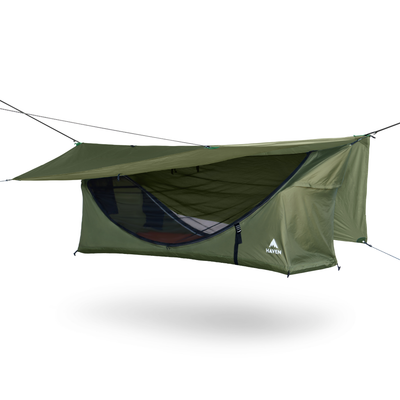
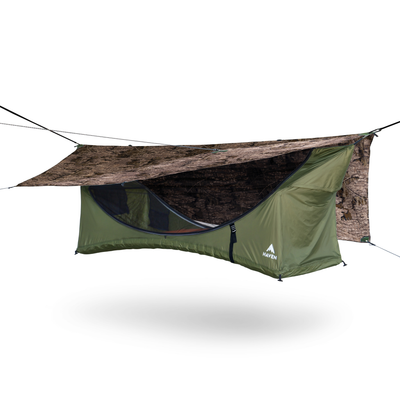
We set out to make sleep the highlight of a camping trip, not the downside. After years of prototypes and testing, we came up with the Haven: it hangs above the ground like a hammock, has a rainfly like a tent, and holds a flat, roomy sleeping platform so you can lie on your back, side or stomach (stomach sleepers, here's your guide).

Three parts of the patented design do the work:
- Spreader bars and the horizontal baffles in the insulated pad hold the sleeping space open, so you can roll over without the sides closing in.
- Like a suspension bridge, support arcs carry the load from end to end, and the sleeping platform hangs below them. That's what keeps the bed flat instead of curved.
- A structural ridgeline keeps the tent from sagging and holds its shape wherever you hang it.
Side sleepers notice the difference. As one verified Haven XL reviewer wrote: "Simple and best camping sleep I have ever had. Side sleepers go to when camping..."
The details of each are in The Secret Design Behind the Haven Tent.
Which Haven fits a side sleeper?
Wider isn't always better. You want the platform to roughly match your shoulder width, so the pad stays flat and doesn't fold along the middle.
| Model | Sleeping platform | Rated capacity | Good fit for |
|---|---|---|---|
| Haven Tent | 24 x 78 in | 285 lb (129 kg) | Smaller to average builds; the lighter, more compact kit |
| Haven XL | 30 x 80 in (76 x 203 cm) | 285 lb (129 kg) | Average to larger builds and taller campers (up to about 6'6" lying stretched out) |
| Haven Spectre | 30 x 80 in (76 x 203 cm) | 285 lb (129 kg) | XL-size platform in our lightest kit, for backpacking |
| Haven Safari | 30 x 80 in (76 x 203 cm) | 350 lb (158 kg) | Heavy-duty canvas for car camping and glamping |
The pad matters too. The True Level pads are thicker in the middle with tapered edges, so they stay level shoulder to shoulder; the Spectre pad (R2.5) is thinner and lighter. More on sizing in Haven Tent or Haven XL?
Tips for sleeping on your side in a Haven
- Get the hang angle right. Aim for 15 to 30 degrees on the straps (hang angle guide). Too tight or too loose changes how level the platform feels.
- Inflate the pad fully. A soft pad lets your hip sink. Top it off with an extra breath or two, especially on cold nights, when the air inside contracts.
- Re-center the pad if you lean. If you drift to one side, the pad has probably shifted. Brace with your knees and push it back to the middle (how to shift the pad).
- Use the ridgeline to roll over. Reach up and use the structural ridgeline to help you turn, rather than pushing on the spreader bars.
- Try it at home first. A night in the backyard tells you more about fit and setup than any spec sheet.

Who may still struggle
- People who sleep curled up tight with knees well out to the side may find a 24 in Haven Tent narrow; the 30 in XL, Spectre and Safari give more room (see Haven Tent or Haven XL?).
- Very restless sleepers who move a lot may notice some movement when they turn over.
- Anyone with hip, shoulder or back pain: a flat bed changes how weight is spread, but we can't promise it helps your condition. Ask your doctor or physical therapist, and see Camping With Back, Hip or Joint Pain.
- Couples who want to sleep side by side: each Haven sleeps one person.
For how a lay-flat hammock compares with a regular one for every sleep position, read Lay-Flat vs Regular Hammock.
FAQ
Can you sleep on your side in a hammock?
Yes, but it depends on the type. In a gathered-end hammock it takes a diagonal lay and the right sag, and many side sleepers still find the curve hard all night. A bridge hammock is flatter. A lay-flat hammock tent is the closest to side sleeping in a bed.
What's the best tent or shelter for side sleepers?
Usually either a lay-flat hammock tent or a roomy ground tent with a thick, wide pad. Choose the hammock tent if you wake up sore on the ground and camp near trees; choose the ground tent if you sleep fine on a good pad, camp without trees, or share a shelter.
Is a bridge hammock good for side sleepers?
For some. It's flatter than a gathered-end hammock and lighter than a lay-flat hammock tent, but most bridge hammocks still sag a little in the middle. If you sleep on your side all night or switch sides often, a lay-flat design is more reliable.
Which Haven is best for side sleepers?
The Haven XL (30 x 80 in) for average to larger builds and taller campers, the Haven Tent (24 x 78 in) for smaller to average builds, the Spectre for backpacking and the Safari (rated to 350 lb) for heavier campers and car camping. Every Haven sleeps one person.
Can I sleep on my side in a Haven without trees?
Yes, on the Haven Stand or a hitch mount, where it hangs as usual. In bivy mode it's pitched on the ground, so you're back on whatever is under you: pick a flat, clear spot.
Where to go next
Read The Most Comfortable Way to Sleep Outside for a comparison of every option, and Are Lay-Flat Hammocks Worth It? for the honest trade-offs. Compare the models in our hammock tents collection, see how a lay-flat system stacks up in Haven vs ground tents, or read the side-sleeper and back-pain answers in our outdoor sleep systems FAQ. For campers on a budget, our Haven Seconds page occasionally lists gently used or repaired Havens at a discount.
We want to hear how it goes. Tag us on Instagram or Facebook or send us an email. As a small business, we really value feedback from our customers.
Here's to a better night of side sleeping!
~ The team at Haven Tents
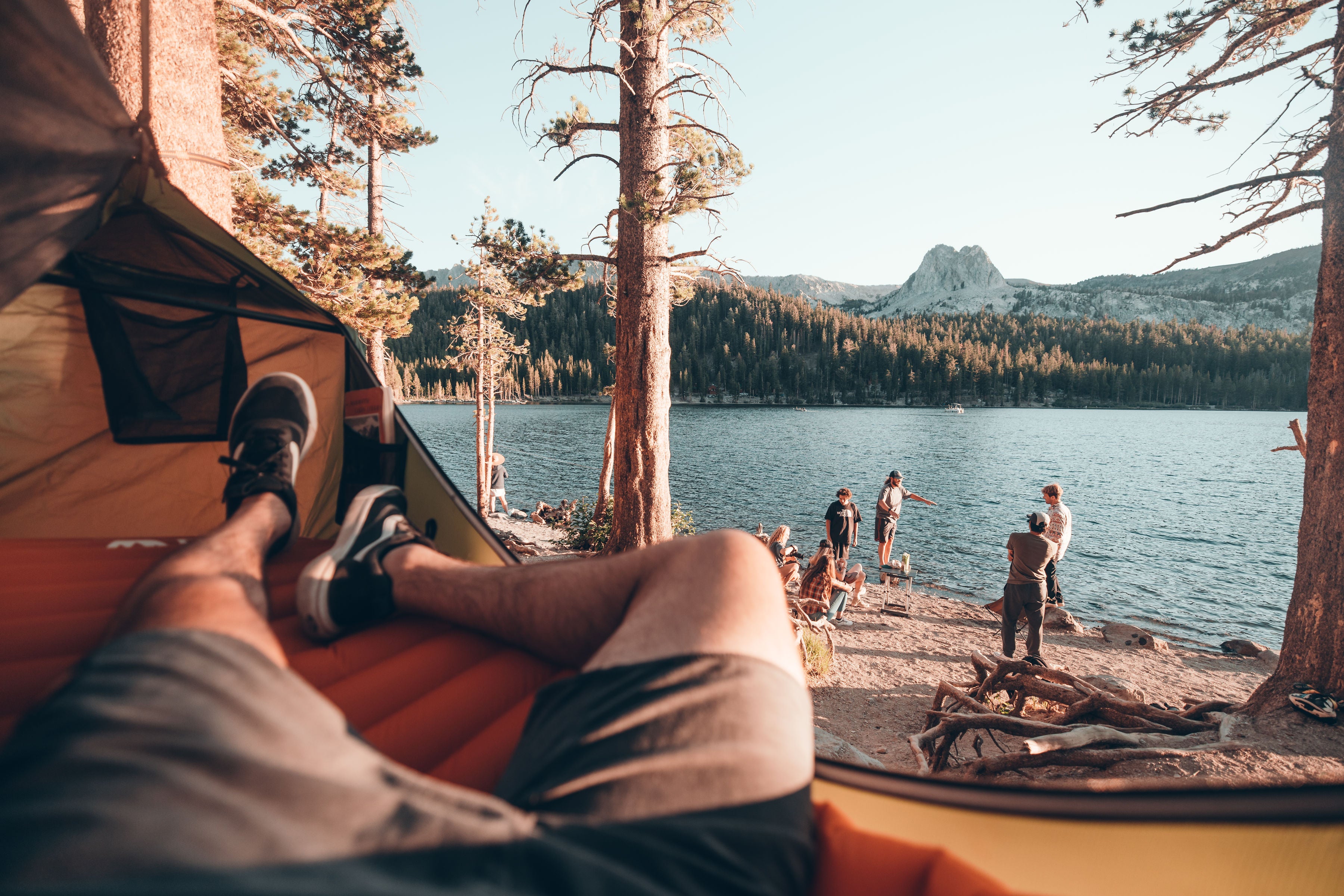
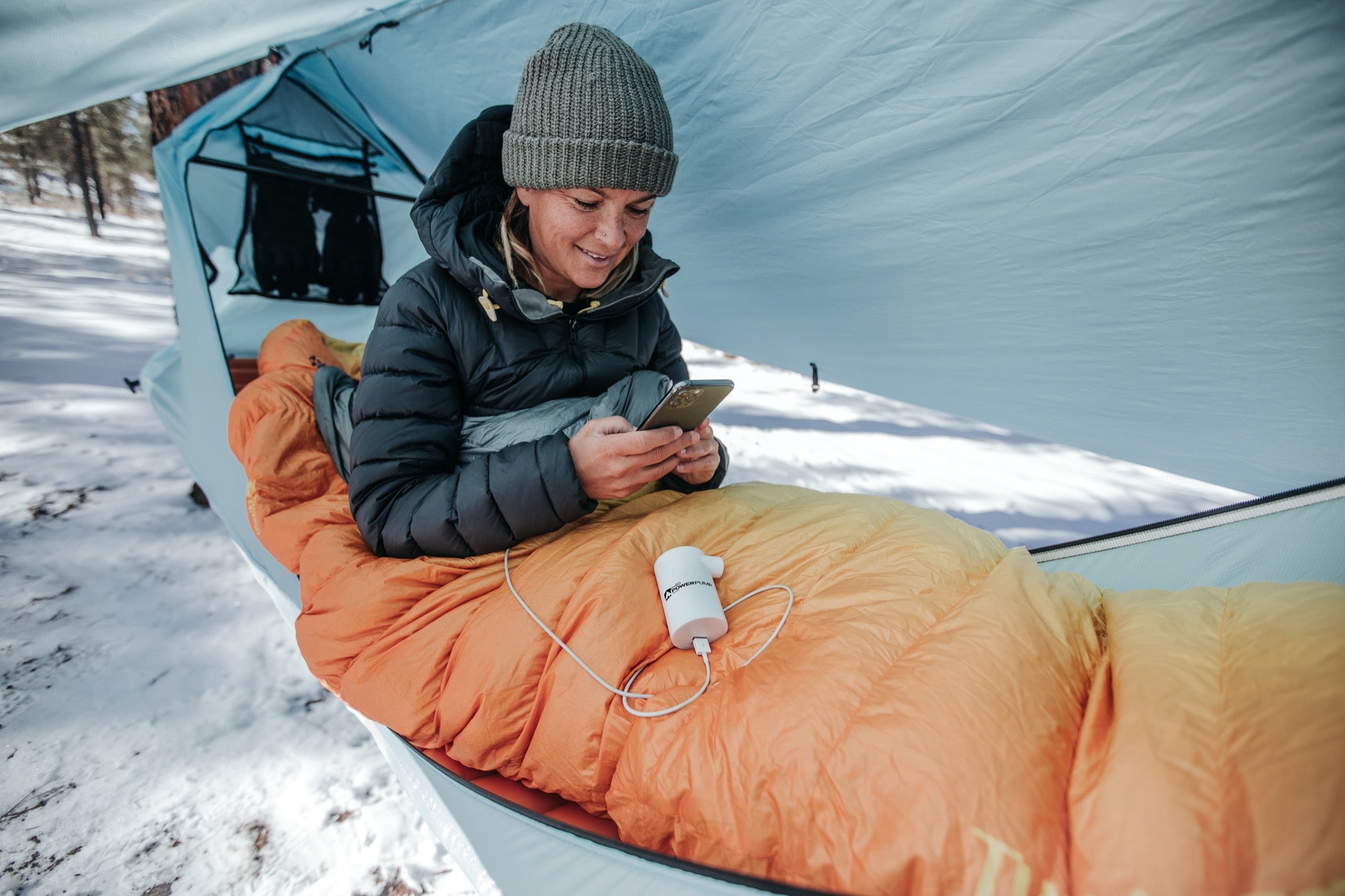
Thanks to @bushcraftjack for providing images for this post. See his full review on YouTube. It's great, but you may need to brush up on your Polish first!
Comments (0)
No comments yet — be the first!
Leave a Comment