Hammock Tent vs Tent on Rocky or Hard-Ground Campsites
Haven Tents · October 21, 2026 · 3 min read

Hammock tent or ground tent on rocky, hard-ground campsites? If there are trees (or you bring a stand), a hammock tent is usually the easier and more comfortable choice: the ground under you doesn't matter, so rocks, roots, slope and packed dirt stop being a problem, and you don't need to drive stakes into anything. Where there's nothing to hang from, like slickrock, scree or a gravel bar with no trees, a freestanding ground tent is simpler, because it stands up without stakes. A Haven can still pitch on the ground in bivy mode there, but then you're on the rock like everyone else.
Why rocky ground is hard on tents
- Finding a flat spot. You need a patch the size of your tent that is level and free of sharp stones. On rocky sites that spot may not exist.
- Stakes won't go in. Many tents need stakes for the corners, vestibules and guylines. On rock and hardpan you tie off to boulders instead, which takes time.
- You feel every lump. A pad softens it, but a rock under your hip is still there at 2 a.m. (see How to Stop Waking Up Sore After Sleeping in a Tent).
- Wear on the floor. Sharp rock can abrade or puncture a tent floor and an air pad. A footprint helps.
Why a hammock tent handles it better (with trees)
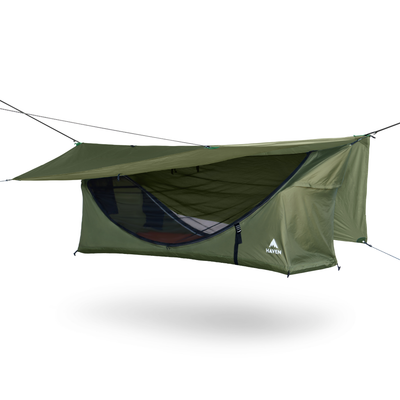
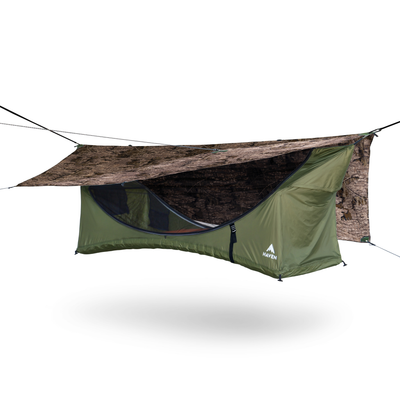
A hung hammock tent only touches the ground with its guylines. You need two healthy trees or other solid anchors, about 12 to 15 ft apart for a Haven, and what's between them can be boulders, roots or a slope. A Haven's flat platform and insulated pad give you the same bed on a rocky ridge as in a pine forest. The same goes for river trips where flat, dry ground is scarce, like our packrafting trip on the Happy River in Alaska.
Comparison
| Ground tent (freestanding) | Hammock tent, hung | Hammock tent in bivy mode |
|---|
| Needs a flat, clear spot | Yes | No | Yes |
| Needs anchors | Stakes or rocks for guylines | Two trees, a stand or a hitch mount | Two poles or sticks, plus stakes or rocks for guylines |
| Comfort on lumpy ground | Depends on your pad | Unaffected | Depends on the spot; the pad helps |
| Wear from rock | Floor and pad at risk; use a footprint | None | Use a footprint (we recommend one for the Spectre's mesh body) |
| People | One or more | One per hammock | One |
Tips for rocky campsites
With a Haven
- Check the anchors first. Trees growing in rocky soil can be shallow-rooted. Use only healthy, solid trees, look up for dead branches, and keep the hang low (hang safe).
- Use rocks for the guylines. If stakes won't go in, tie the rainfly guylines around a heavy rock or a boulder.
- Bring longer suspension if trees are widely spaced; Whoopie Slings or Spectre Straps add reach.
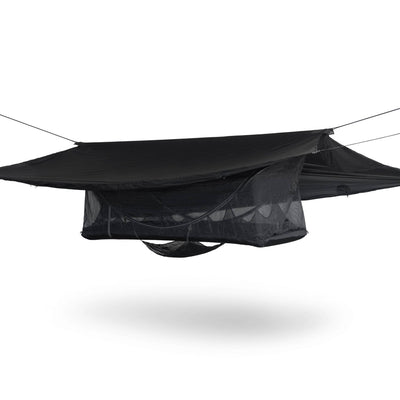
- No trees? Pitch in bivy mode on the smoothest spot you can find, with a footprint under it. The Haven Spectre's mesh body isn't waterproof, so we recommend a footprint under it on the ground. More in Going to Ground.
With a ground tent
- Choose a freestanding tent, and carry a footprint.
- Clear loose stones before you pitch and lie down to test the spot.
- Use a thicker pad, and tie guylines to rocks when stakes won't hold.
Which should you choose?
- Rocky sites with trees (forests, river corridors, canyon bottoms): a hammock tent.
- Treeless rock, scree or alpine sites: a freestanding ground tent, or a Haven in bivy mode if you also camp among trees.
- Car camping on gravel or hardpan: a Haven on the Haven Stand on firm, reasonably level ground, or a tent with a good pad.
Read Hammock Tent vs Ground Tent for the backpacking trade-offs, Using a Hammock Tent at Campgrounds for developed sites, and see when a ground tent wins on our Haven vs Ground Tents page. Our outdoor sleep systems page shows every model.
← Back to Adventure Journal
<div class="dynamic-checkout__content" id="dynamic-checkout-cart" data-shopify="dynamic-checkout-cart"> <shopify-accelerated-checkout-cart wallet-configs="[{"supports_subs":true,"supports_def_opts":false,"name":"shop_pay","wallet_params":{"shopId":11057397823,"merchantName":"Haven Tents","personalized":true}},{"supports_subs":true,"supports_def_opts":false,"name":"paypal","wallet_params":{"shopId":11057397823,"countryCode":"US","merchantName":"Haven Tents","phoneRequired":true,"companyRequired":false,"shippingType":"shipping","shopifyPaymentsEnabled":true,"hasManagedSellingPlanState":false,"requiresBillingAgreement":true,"gatewayType":"CONNECTED","merchantId":"AT9YPQVBATPVS","sdkUrl":"https://www.paypal.com/sdk/js?components=buttons\u0026commit=false\u0026currency=USD\u0026locale=de_DE\u0026client-id=AexZEtAxk09Ncgj6FSWFFyGKbxxAZ_LTyJ2DPdJWl1YUlecinmc5AfIaRF2qYjWlusWahlzz6SVkY5Ci\u0026merchant-id=AT9YPQVBATPVS\u0026intent=authorize","serviceableCountryCodes":["AC","AD","AE","AF","AG","AI","AL","AM","AO","AR","AT","AU","AW","AX","AZ","BA","BB","BD","BE","BF","BG","BH","BI","BJ","BL","BM","BN","BO","BQ","BR","BS","BT","BW","BY","BZ","CA","CC","CD","CF","CG","CH","CI","CK","CL","CM","CN","CO","CR","CV","CW","CX","CY","CZ","DE","DJ","DK","DM","DO","DZ","EC","EE","EG","EH","ER","ES","ET","FI","FJ","FK","FO","FR","GA","GB","GD","GE","GF","GG","GH","GI","GL","GM","GN","GP","GQ","GR","GS","GT","GW","GY","HK","HN","HR","HT","HU","ID","IE","IL","IM","IN","IO","IQ","IS","IT","JE","JM","JO","JP","KE","KG","KH","KI","KM","KN","KR","KW","KY","KZ","LA","LB","LC","LI","LK","LR","LS","LT","LU","LV","LY","MA","MC","MD","ME","MF","MG","MK","ML","MM","MN","MO","MQ","MR","MS","MT","MU","MV","MW","MX","MY","MZ","NA","NC","NE","NF","NG","NI","NL","NO","NP","NR","NU","NZ","OM","PA","PE","PF","PG","PH","PK","PL","PM","PN","PS","PT","PY","QA","RE","RO","RS","RU","RW","SA","SB","SC","SD","SE","SG","SH","SI","SJ","SK","SL","SM","SN","SO","SR","SS","ST","SV","SX","SZ","TA","TC","TD","TF","TG","TH","TJ","TK","TL","TM","TN","TO","TR","TT","TV","TW","TZ","UA","UG","UM","US","UY","UZ","VA","VC","VE","VG","VN","VU","WF","WS","XK","YE","YT","ZA","ZM","ZW"]}}]" access-token="20cee07b2f5277b40ccae45e245d3c77" buyer-country="US" buyer-locale="de" buyer-currency="USD" shop-id="11057397823" cart-id="4ba8c5673d0f052b0b4c65898a2180ed" enabled-flags="["a1d1f9a1","f5afabb3","370070f3","b311f899"]" > <div class="wallet-button-wrapper"> <ul class='wallet-cart-grid wallet-cart-grid--skeleton' role="list" data-shopify-buttoncontainer="true"> <li data-testid='grid-cell' class='wallet-cart-button-container'><div class='wallet-cart-button wallet-cart-button__skeleton' role='button' disabled aria-hidden='true'> </div></li><li data-testid='grid-cell' class='wallet-cart-button-container'><div class='wallet-cart-button wallet-cart-button__skeleton' role='button' disabled aria-hidden='true'> </div></li> </ul> </div> </shopify-accelerated-checkout-cart> </div>



Comments (0)
No comments yet — be the first!
Leave a Comment