Sleeping Pad Alternatives: Ways to Sleep Off the Ground When Camping
Haven Tents · October 21, 2026 · 3 min read

What are the alternatives to a sleeping pad? If you want to sleep off the ground, the main options are a camping cot, a traditional hammock with an underquilt, a lay-flat hammock tent with a built-in pad, a rooftop tent with its own mattress, or sleeping in your vehicle on a platform. If you just want something other than an inflatable pad on the ground, closed-cell foam pads and self-inflating pads are alternatives too. Each trades comfort, warmth, weight and where it works differently, and most still need some insulation under you, because cold comes from below.
Off-the-ground options compared
| Option | How you sleep | Insulation underneath | Where it works | Main trade-off |
|---|
| Camping cot | Flat, firm fabric off the ground | Cold air underneath; add a pad on cool nights | Car camping, inside a big tent | Bulky and heavy |
| Traditional hammock | Curved; lie diagonally | Needs an underquilt or pad | Between trees | The banana shape doesn't suit many side and stomach sleepers |
| Lay-flat hammock tent | Flat, on an insulated air mattress held in a frame | Insulated pad built in | Trees, a stand or hitch mount; or on the ground in bivy mode | One person each; heavier than a bare hammock |
| Rooftop tent | Flat mattress on your vehicle | Built-in mattress | Wherever you can park | Expensive, tied to your vehicle |
| Vehicle sleeping platform | Mattress in the back of your car or truck | Whatever mattress you bring | Wherever you can park | Space, condensation and privacy |
Camping cots
A cot puts you on a flat, taut surface off the ground, so rocks and roots don't matter. It's a good fit for car camping if you have room in the vehicle and a tent tall enough for it. On cool nights, air under the cot makes it cold, so many people put a pad or blanket on top, which means it isn't a full pad replacement in every season.
Traditional hammocks
A gathered-end hammock is light, packs small and keeps you completely off the ground. It needs trees, a tarp and a bug net, and an underquilt for warmth. Many back sleepers love them; side and stomach sleepers often struggle with the curve. Lying diagonally helps.
Lay-flat hammock tents
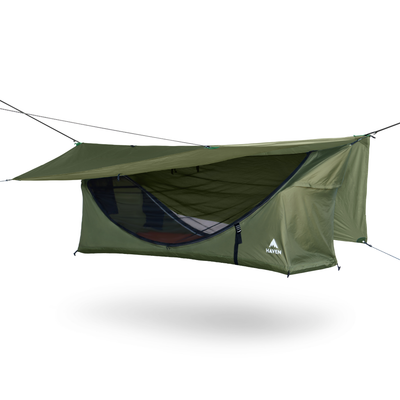
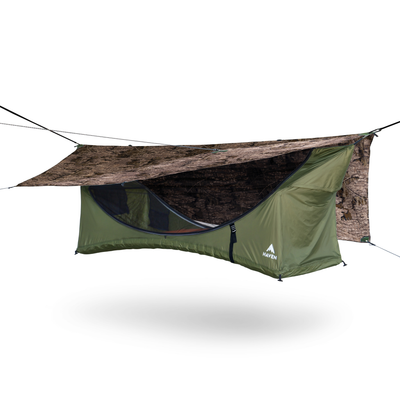
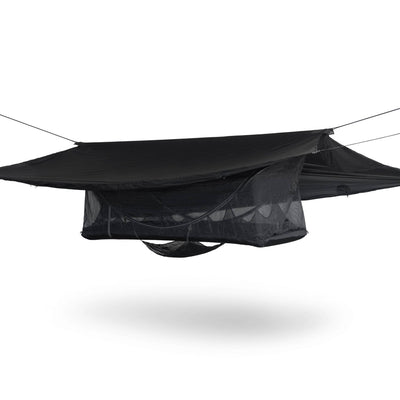
A lay-flat hammock tent like the Haven doesn't replace the pad so much as build it in: an insulated air mattress sits in a suspended frame that holds it flat, with a rainfly and bug net included. The pad is part of the structure, sized to the frame so it stays put (why we recommend our pad). You get a flat bed off the ground for back, side or stomach sleeping, and you don't need an underquilt. The Insulated Pad Cover adds warmth for colder trips (cold-weather guide).
Trade-offs: one person per Haven, two anchor points needed (or a stand), and more weight than a bare hammock. With no trees, it pitches on the ground in bivy mode.
Rooftop tents and vehicle platforms
If you car camp, sleeping on or in your vehicle gets you off the ground on a real mattress. Rooftop tents are comfortable and quick to deploy but expensive, and you have to pack up camp to drive anywhere. Sleeping in the back of an SUV or truck on a platform is cheap if your vehicle is long enough, but it can be cramped and damp from condensation. We compare these for car camping in Best Car Camping Sleep Setup.
On-the-ground alternatives to an air pad
- Closed-cell foam pads: can't puncture, cheap and light, but thin, so less cushioning for side sleepers.
- Self-inflating pads: foam plus air; firmer and more durable than many air pads, but bulkier.
- Stacking pads: a foam pad under an air pad adds warmth and puncture protection.
Which should you choose?
- Car camping with space: a cot with a pad, a rooftop tent, or a lay-flat hammock tent on a stand or hitch mount.
- Camping among trees and want a flat bed: a lay-flat hammock tent.
- Backpacking, lowest weight: a good pad in a light tent, or a traditional hammock if you sleep well in one.
- Sore on the ground every trip: try something off the ground; see How to Stop Waking Up Sore After Sleeping in a Tent.
More comparisons: Do You Need a Sleeping Pad If You Sleep Off the Ground?, Camping With Back, Hip or Joint Pain, Hammock vs Cot vs Sleeping Pad, Haven vs Ground Tents, and our outdoor sleep systems guide.
← Back to Adventure Journal
<div class="dynamic-checkout__content" id="dynamic-checkout-cart" data-shopify="dynamic-checkout-cart"> <shopify-accelerated-checkout-cart wallet-configs="[{"supports_subs":true,"supports_def_opts":false,"name":"shop_pay","wallet_params":{"shopId":11057397823,"merchantName":"Haven Tents","personalized":true}},{"supports_subs":true,"supports_def_opts":false,"name":"paypal","wallet_params":{"shopId":11057397823,"countryCode":"US","merchantName":"Haven Tents","phoneRequired":true,"companyRequired":false,"shippingType":"shipping","shopifyPaymentsEnabled":true,"hasManagedSellingPlanState":false,"requiresBillingAgreement":true,"gatewayType":"CONNECTED","merchantId":"AT9YPQVBATPVS","sdkUrl":"https://www.paypal.com/sdk/js?components=buttons\u0026commit=false\u0026currency=USD\u0026locale=de_DE\u0026client-id=AexZEtAxk09Ncgj6FSWFFyGKbxxAZ_LTyJ2DPdJWl1YUlecinmc5AfIaRF2qYjWlusWahlzz6SVkY5Ci\u0026merchant-id=AT9YPQVBATPVS\u0026intent=authorize","serviceableCountryCodes":["AC","AD","AE","AF","AG","AI","AL","AM","AO","AR","AT","AU","AW","AX","AZ","BA","BB","BD","BE","BF","BG","BH","BI","BJ","BL","BM","BN","BO","BQ","BR","BS","BT","BW","BY","BZ","CA","CC","CD","CF","CG","CH","CI","CK","CL","CM","CN","CO","CR","CV","CW","CX","CY","CZ","DE","DJ","DK","DM","DO","DZ","EC","EE","EG","EH","ER","ES","ET","FI","FJ","FK","FO","FR","GA","GB","GD","GE","GF","GG","GH","GI","GL","GM","GN","GP","GQ","GR","GS","GT","GW","GY","HK","HN","HR","HT","HU","ID","IE","IL","IM","IN","IO","IQ","IS","IT","JE","JM","JO","JP","KE","KG","KH","KI","KM","KN","KR","KW","KY","KZ","LA","LB","LC","LI","LK","LR","LS","LT","LU","LV","LY","MA","MC","MD","ME","MF","MG","MK","ML","MM","MN","MO","MQ","MR","MS","MT","MU","MV","MW","MX","MY","MZ","NA","NC","NE","NF","NG","NI","NL","NO","NP","NR","NU","NZ","OM","PA","PE","PF","PG","PH","PK","PL","PM","PN","PS","PT","PY","QA","RE","RO","RS","RU","RW","SA","SB","SC","SD","SE","SG","SH","SI","SJ","SK","SL","SM","SN","SO","SR","SS","ST","SV","SX","SZ","TA","TC","TD","TF","TG","TH","TJ","TK","TL","TM","TN","TO","TR","TT","TV","TW","TZ","UA","UG","UM","US","UY","UZ","VA","VC","VE","VG","VN","VU","WF","WS","XK","YE","YT","ZA","ZM","ZW"]}}]" access-token="20cee07b2f5277b40ccae45e245d3c77" buyer-country="US" buyer-locale="de" buyer-currency="USD" shop-id="11057397823" cart-id="4886f86d4b205cfa67526927e51a7094" enabled-flags="["a1d1f9a1","f5afabb3","370070f3","b311f899"]" > <div class="wallet-button-wrapper"> <ul class='wallet-cart-grid wallet-cart-grid--skeleton' role="list" data-shopify-buttoncontainer="true"> <li data-testid='grid-cell' class='wallet-cart-button-container'><div class='wallet-cart-button wallet-cart-button__skeleton' role='button' disabled aria-hidden='true'> </div></li><li data-testid='grid-cell' class='wallet-cart-button-container'><div class='wallet-cart-button wallet-cart-button__skeleton' role='button' disabled aria-hidden='true'> </div></li> </ul> </div> </shopify-accelerated-checkout-cart> </div>



Comments (0)
No comments yet — be the first!
Leave a Comment