
What's the best way to camp with back, hip or joint pain? Look for three things in your sleep setup: a surface that stays flat and evenly supports you, enough cushioning that your hips and shoulders don't press through to something hard, and a bed you can get into and out of without a struggle. A thick pad in a tent, a cot and a lay-flat hammock tent each get some of this right, and a traditional hammock gets most of it wrong for many people. Which one suits you depends on where it hurts, how you sleep and how easily you get up from the floor. We make the Haven, so we're not neutral, and we can't tell you what's right for your body: if you have a back, hip or joint condition, ask your doctor or physical therapist before changing how you sleep.

What to look for in a camping bed when something hurts
- Flat, even support. A surface that sags in the middle or tilts on a slope puts your body at an angle all night.
- Cushioning at the pressure points. Side sleepers carry most of their weight on the hip and shoulder. If those press through a thin pad to the ground, you'll feel it.
- Getting in and out. Getting up off the ground several times a night is hard on knees, hips and backs. A bed at sitting height is easier.
- Warmth underneath. Cold ground or cold air under you pulls heat away. Being warm and dry makes it easier to stay in one comfortable position.
- Room to change position. If you need to roll over or bend your knees, a bed that closes in around you makes that harder.
Sleeping pad, cot, hammock or lay-flat hammock tent compared
| Thick pad in a tent | Camping cot | Traditional hammock | Lay-flat hammock tent | |
|---|---|---|---|---|
| Surface | Flat if the ground is flat | Flat, taut fabric | Curved like a banana | Flat air mattress held in a suspended frame |
| Hip and shoulder pressure | Depends on pad thickness and the ground below | Firm; many people add a pad | Shoulders squeezed by the sides | Spread across an air mattress, off the ground |
| Getting in and out | Down to the floor and back up | Sit on the edge at about chair height | Can swing or tip as you get in | Sit on the low side wall, then lie back |
| Warmth underneath | From the pad | Cold air under the fabric unless you add a pad | Needs an underquilt or pad | Insulated pad built in |
| Rocks, roots and slope | You feel them | Needs level ground | Don't matter | Don't matter when hung |
| Where it works | Anywhere you can pitch a tent | Car camping; inside a large tent | Two trees | Two trees, a stand or a hitch mount |
Which setup might suit you
If hip or shoulder pressure keeps you awake
This is the common complaint from side sleepers on a pad. A thicker pad helps on smooth ground. A lay-flat hammock tent puts your whole length on an air mattress with nothing hard below it, which is why many side sleepers choose one (see Hammocking for Side Sleepers). A bare cot is firm, so most people add a pad on top.
If getting up from the floor is the hard part
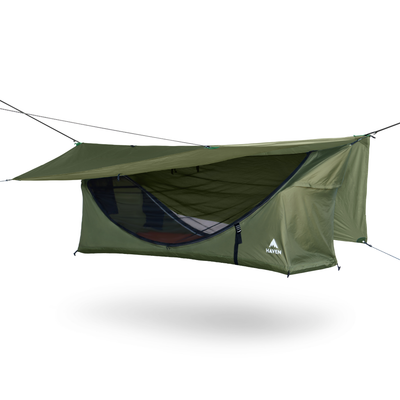
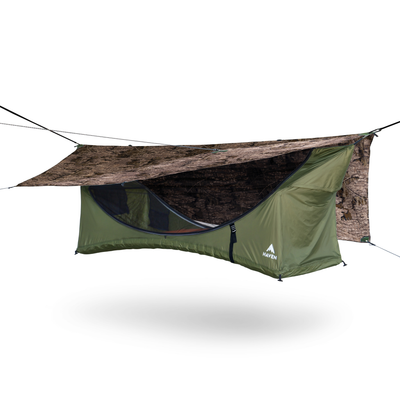
A cot is the easiest bed to get onto and off: you sit down and stand up as you would from a chair. A Haven is next: hung low, you sit on the side wall and swing your legs in, and you can hold the ridgeline strap while you do it (how Haven stability works). A pad in a tent means kneeling, crawling and getting up from the floor every time.
If your back dislikes a curve
A gathered-end hammock bends you into a banana shape unless you lie diagonally, and even then it isn't flat. A bridge hammock is flatter. A lay-flat hammock tent, a cot or a pad on level ground keeps you flat. Can You Sleep Flat in a Hammock? explains the difference.
If you camp where the ground is rough
Rocks, roots and slopes are where a pad struggles. A hung bed doesn't touch the ground, and a cot needs a level spot. See Hammock Tent vs Tent on Rocky Ground.
Setup details that change how you feel in the morning
- Pad firmness. Too soft and you sink to the ground or the cot frame; too firm and it pushes back at the hips. Adjust a little at a time. In a Haven XL, firmness also affects how flat the platform sits (tips for the XL).
- Level it. A cot or pad on a slope tips you all night. In a hammock tent, get the hang angle right (hang angle guide).
- Use a real pillow, and add a small one between or under your knees if that's what you do at home.
- Stay warm. Use insulation underneath and a bag rated for the night's low.
- Keep it low. Hang a hammock tent low so getting in and out is easy and any fall is short (hang safe).
- Try it at home first. Sleep a night in the backyard before you commit to a trip.
When a Haven isn't the right choice
- You need to sit fully upright to get in and out. A cot at chair height is easier for some people than lowering yourself onto a hung bed.
- You can't put up or take down the straps. A Haven hangs from straps you wrap around two trees and clip to the hammock; if reaching and wrapping straps is a problem, a cot or a car-camping setup may be simpler.
- Your campsites have no trees and you don't want to bring a stand. The Haven Stand solves this for car camping but adds weight and bulk.
- You want to share a bed with a partner. Each Haven sleeps one person.
- You already sleep well on a thick pad or cot. Then there's no reason to change.
If you do try a Haven and it doesn't work for you, our 60-day returns apply to new tents.
Questions to take to your doctor or physical therapist
We can describe how each bed supports you; we can't tell you which is safe or helpful for your condition. Useful questions to ask:
- Should I sleep on my back, side or stomach, and with a pillow under or between my knees?
- Is a firm or softer surface better for me?
- Is getting up from the floor, or sitting down onto a low bed, something I should avoid?
- Are there positions I should avoid for a whole night?
More on sleeping well outside
Read How to Stop Waking Up Sore After Sleeping in a Tent, Hammock vs Cot vs Sleeping Pad and Do You Need a Sleeping Pad If You Sleep Off the Ground?. To compare a Haven with a tent and pad on everything else, see Haven vs Ground Tents, and see the full lineup, from the Haven Tent and Haven XL to the Haven Safari, on our outdoor sleep systems page.


Comments (0)
No comments yet — be the first!
Leave a Comment