

What is the best tent for car camping? There is no single best one. For most drive-up campers it is a tent rated for one or two more people than will sleep in it, tall enough to stand in, with a full-coverage rainfly, mesh for airflow, two doors and a vestibule for wet gear.
Your car carries the tent, so weight barely matters. What matters is whether your bed fits with room to spare, whether you can stand up to change, how the tent handles your weather, and how easily it pitches and packs. This guide covers the tent. The bed inside it is covered in Best Car Camping Sleep Setup.
Our pick: For a couple or a family sharing one shelter, choose a cabin-style tent or a tall dome, sized up from its label. Go cabin for standing room and cots, dome for windy sites, and an instant tent only if a fast pitch matters more than packed size and wind stability. If your tent is fine and the thing keeping you awake is the ground, a lay-flat hammock tent is the better choice, and the Haven Safari is our car-camping model. Every Haven sleeps one person and needs two anchor points (trees, a stand or a hitch mount) or ground bivy mode. Don't buy one if your family wants one shelter, if you want to share one bed, if you camp without trees and won't bring a stand, or if you want the lowest possible pack weight.
What is the most comfortable car camping tent?
The most comfortable car camping tent is one you can stand up in, with floor space for a real bed plus room to walk around it, and enough airflow and rain cover to stay dry inside. For most people that is a cabin-style tent or a tall dome. Which one depends on what comfort means to you:
- Standing room: near-vertical walls let you stand anywhere, not just in the middle.
- Usable floor: space for the bed, your bags, and a clear way to the door.
- Covered space outside: a vestibule or awning for wet boots and a cooler.
- Dry air: mesh and vents that let damp air out, under a fly that keeps rain off.
No tent wins on all four. A tall, airy cabin is less steady in wind, and a low, storm-ready dome has less headroom.
Car camping tent types compared
| Type | Space and headroom | Setup | Wind and rain | Packed size | Suits |
|---|---|---|---|---|---|
| Dome | Sloped walls; standing room only near the center | Simple; freestanding | Sheds wind well when guyed out | Compact | Couples, small families, exposed sites |
| Cabin | Near-vertical walls; standing room throughout | More poles; easier with two people | Tall, flat walls catch wind | Large and heavy | Families, cot users, fair-weather stays |
| Instant or hub (pop-up) | Usually cabin-shaped, so good headroom | Fastest; poles stay attached | Often the least steady in wind; some have only a partial rainfly | Long or bulky; check your trunk | Short trips, late arrivals |
| Tunnel | Roomy; often a covered porch | Not freestanding; must be staked and guyed | Steady when pitched end-on to the wind | Moderate | Wet climates, covered living space |
| Cotton canvas (bell or wall tent) | Very roomy; standing height | Slowest; many stakes | Sturdy; breathable, so less condensation | Heaviest; must be stored fully dry | Basecamps, week-long stays |
| Lay-flat hammock tent | A bed, not a room: lying down only, one person each | Hangs from two trees, a stand or a hitch mount | Off wet ground under a rainfly; no room to sit out a storm | Small | Campers whose problem is the ground |
How big a car camping tent do you need?
Size the tent to your bed, not to the number on the label. Capacity ratings assume people lying shoulder to shoulder on narrow pads. As a rule of thumb, size up by one person for comfort, and by two for a big mattress, cots or bags indoors.
- Measure the bed. A queen mattress is about 60 x 80 in and a full (double) about 54 x 75 in. Compare that with the tent's floor dimensions and leave space to get in and out.
- Allow for sloped walls. Floor dimensions are measured at ground level. A thick mattress lifts you into the slope, so a dome feels smaller than its floor plan.
- Cots need straight walls. A cot frame can't tuck under a sloped wall, so cot users do best in a cabin tent.
- Read peak height carefully. It is measured at the highest point. In a dome that is one spot in the middle.
- Check the site. A bigger tent needs a bigger flat spot, and some tent pads are small.
What's the best car camping tent that sets up quickly?
The quickest car camping tents to set up are instant cabin tents and hub-style pop-up tents, because their poles stay attached to the tent and you unfold the frame instead of threading poles through sleeves. Speed costs you three things:
- Packed size. A pre-attached frame can't break down as small as loose poles. Hub tents fold into a long bag, and instant cabins into a thick, heavy bundle. Measure your trunk first.
- Wind stability. Tall, flat walls on a jointed frame flex more than a low dome with crossing poles. Use every stake and guyline.
- Rain cover. Some quick-pitch tents have a rainfly that covers only the roof. If you camp in rain, look for one that comes well down the walls.
Advertised setup times usually cover standing the tent up. Staking, guying out and fitting the rainfly take about as long as on any other tent. A simple dome with two crossing poles is not far behind, packs smaller and handles wind better.
What is the best car camping tent for two people?
For two people car camping, the best fit is usually a tent rated for three or four people, not two, because a two-person rating leaves room for two narrow pads and little else.
- Three-person: fits two single pads side by side with bags at your feet. It suits small sites and small cars.
- Four-person: fits a double or queen mattress with space beside it. Pick this if you share one bed.
Two doors, a vestibule and enough height to sit up and change matter most. If you would each rather have your own flat bed off the ground, the alternative is two Havens side by side. A Haven sleeps one.
What's the best car camping tent for couples who want to sleep well?
Couples who want to sleep well should choose the tent around the bed: one rated for at least three or four people that fits a double mattress with space on both sides, has a door for each of you, and ventilates well. The tent decides four of the things that wake you:
- Night exits. With two doors, nobody climbs over anybody.
- Damp. Two people breathe out a lot of moisture. Open the vents, and see Managing Condensation While Camping.
- Early light. Darker fabric, a full rainfly and a shaded pitch all cut it.
- Clutter. A vestibule keeps bags and boots off the bed.
The bed decides the rest. If one of you sleeps badly on any ground bed, the other honest option is two Havens hung side by side: a flat, insulated bed each, but separate beds, because a Haven sleeps one.
Weather and ventilation: what to check
- Rainfly coverage. A full-coverage fly reaches close to the ground and protects the walls in wind-driven rain. A partial fly is airier in fair weather but leaves more of the tent exposed.
- Mesh and vents. Mesh panels and a high vent you can leave open in rain move damp air out.
More in Wet Weather Camping: Keep Your Tent Dry.
When the tent is fine and the ground is the problem
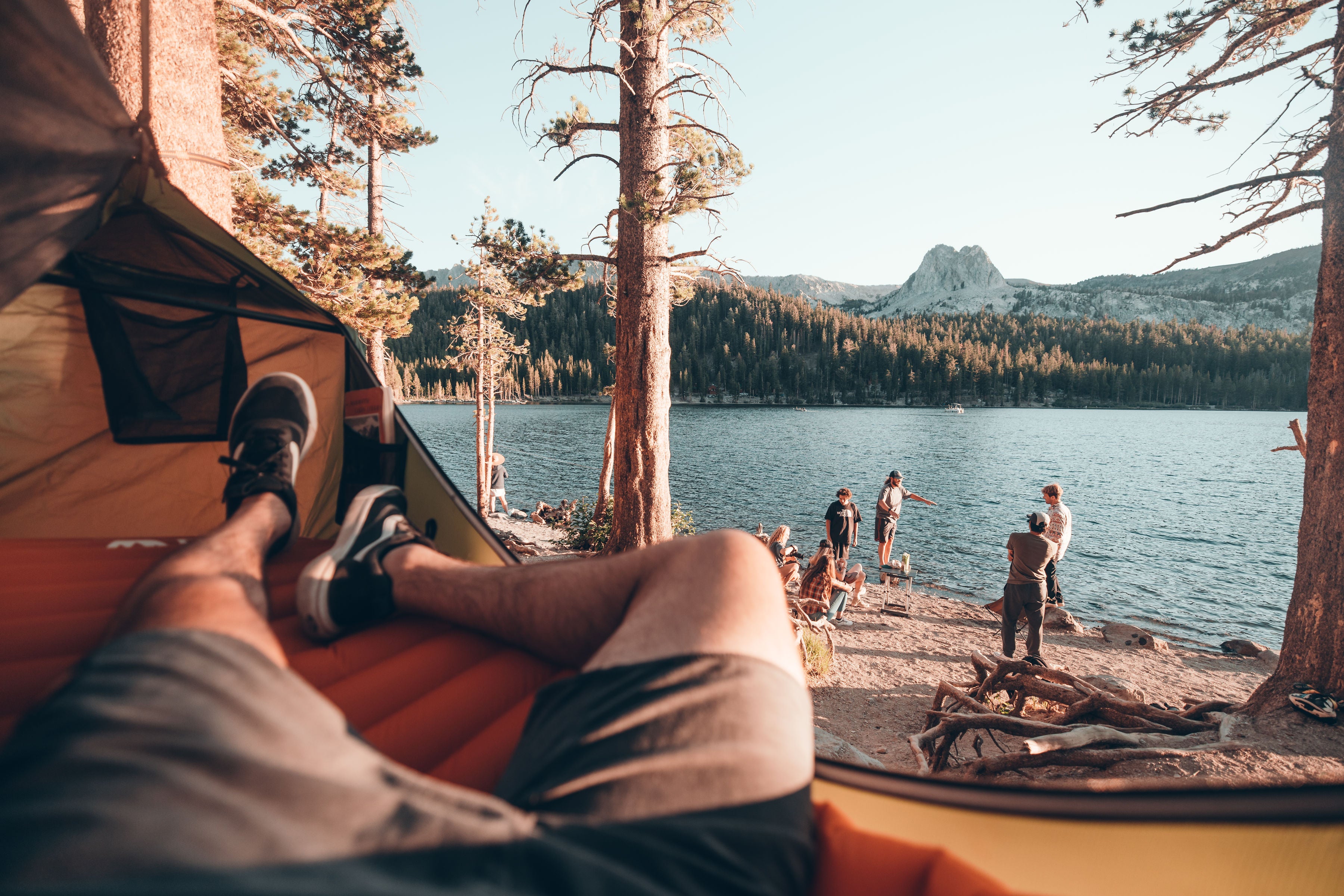
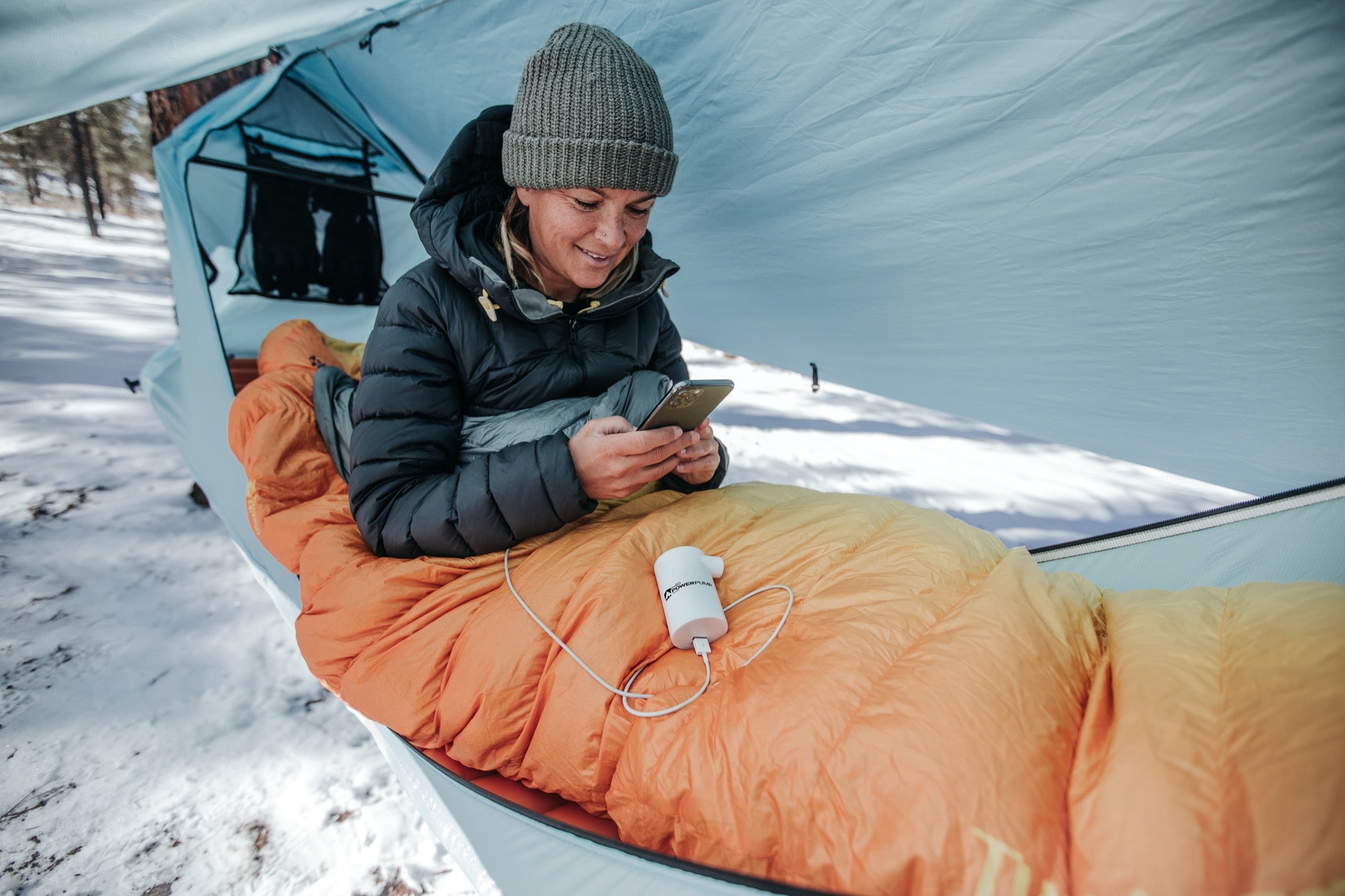
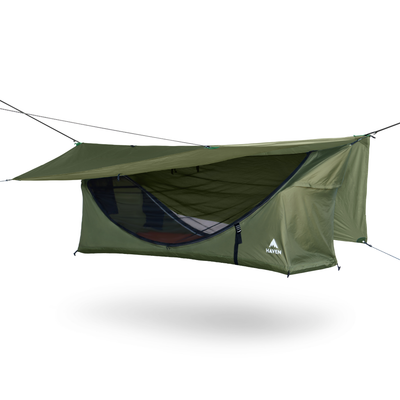
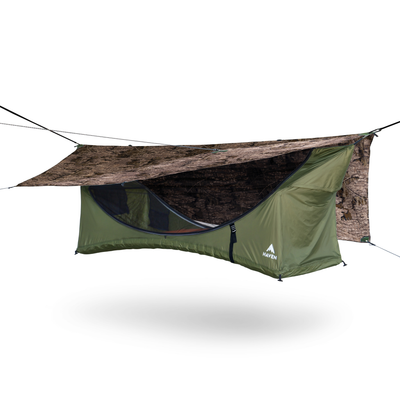
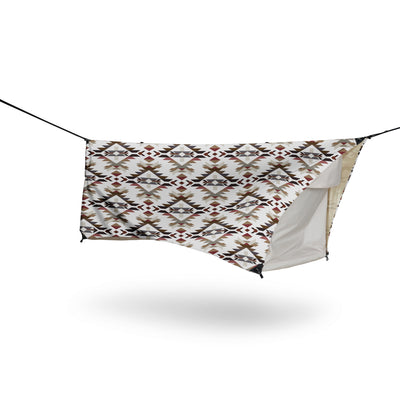
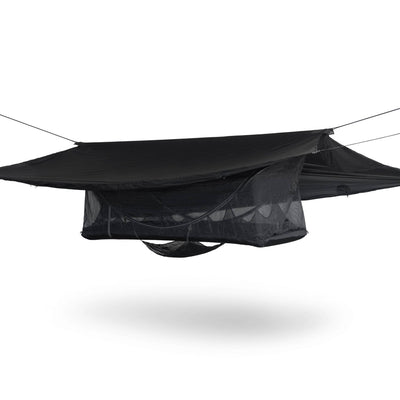
A bigger tent still puts you on the ground. If rocks, slope or a sagging air bed wake you, change the bed. A Haven is a flat bed with a built-in bug net, a rainfly and an insulated air mattress in one kit. The Haven Safari is built for car camping and glamping: 300d polyester canvas, a 30 x 80 in (76 x 203 cm) platform and a 350 lb (158 kg) weight rating. It is our heaviest model: the lightest kit is 9 lb 2 oz / 4140 g and packs to 20 x 10 x 5 in (50 x 25 x 13 cm).
The limits: it sleeps one, it needs two trees, a stand or a hitch mount (or it pitches on the ground in bivy mode), and you can't stand up or change inside. Some families keep a tent for the kids and hang Havens for the adults. More in Hammock Tent vs Ground Tent.
Which should you choose?
- Family sharing one shelter: a cabin tent rated for two more people than you have.
- Couple sharing one mattress: a four-person cabin or tall dome with two doors.
- Couple on two pads, with a small car or small sites: a three-person dome.
- Windy or rainy sites: a dome or tunnel with a full rainfly.
- Late arrivals and one-night stops: an instant or hub tent, if it fits your vehicle.
- A week in one place: a canvas tent.
- You sleep badly on the ground and camp among trees or bring a stand: a Haven Safari each.
Related guides: How to Choose the Most Comfortable Tent for Sleeping, How to Choose a Camping Tent.
Common questions
What is the best tent for car camping?
The best tent for car camping is one that fits your bed and your group with room to spare. For most people that is a cabin-style tent or tall dome rated for one or two more people than will sleep in it, with a full rainfly and two doors.
Is a cabin tent or a dome tent better for car camping?
A cabin tent is better for standing room, cots and long stays. A dome is better in wind, on small sites and in a small trunk.
Will a queen air mattress fit in a four-person tent?
Often, but check the floor dimensions. A queen is about 60 x 80 in, and you want space beside it to get in and out.
Can two people share a Haven?
No. Every Haven sleeps one person, and couples hang two side by side. If you want to share one bed, choose a tent and a double mattress.
Can you use a Haven at a drive-up campsite with no trees?
Yes, on a stand, on a vehicle hitch mount, or on the ground in bivy mode. The Haven Stand is rated to 300 lb, which is below the Safari's 350 lb rating. Campground rules on hammocks vary, so check first. See Using a Hammock Tent at Campgrounds with Tent Pads.
Comments (0)
No comments yet — be the first!
Leave a Comment