
What is an outdoor sleep system, and do you need one? It's everything you use to sleep outside, working together: shelter from weather and bugs, a surface that supports you, insulation underneath you, and bedding on top. Anyone who sleeps outside needs one and already has one, even if it's just a tent, pad and sleeping bag.
On mild trips a simple setup is enough; cold, wet, windy or weight-sensitive trips call for more careful choices. The real question is whether to piece it together from separate parts or buy an all-in-one system such as a lay-flat hammock tent, which combines the shelter, the bed and the insulation in one kit. Separate parts are more flexible and can be shared; an all-in-one system is simpler and is built around sleeping well.
Our pick: If you already sleep well on a pad, keep your tent and pad and upgrade only the part that's letting you down. If you sleep on your side or stomach, wake up sore or cold on the ground, and camp where there are trees (or can bring a stand), a lay-flat hammock tent is the most complete all-in-one system we know: shelter, bug net, rainfly, a flat bed and an insulated pad in one kit, with only your sleeping bag or quilt to add. For car camping and the roomiest bed, choose the Haven XL or Haven Safari; for backpacking, the Haven Spectre. For a family, or a couple who want to share one bed, a tent with good pads or mattresses is the better system.

The parts of a sleep system
- Shelter. Keeps rain, wind and bugs off you: a tent, a tarp and bug net, or a rainfly.
- Support. What you actually lie on: the ground with a pad, a cot, a hammock or a flat suspended platform. This decides whether you can sleep in your normal position.
- Insulation underneath. The ground or the air under you pulls heat away faster than the air above, and a sleeping bag compresses under your weight. A pad (or an underquilt in a hammock) does this job.
- Bedding on top. A sleeping bag or quilt rated for the night's low, plus a pillow.
If any one part is wrong, you sleep badly: a warm bag on a thin pad still leaves you cold, and a great tent on lumpy ground still leaves you sore.
Some gear brands use "sleep system" more narrowly, for just the sleeping bag, pad and pillow. We include the shelter and what you lie on, because those decide whether you can sleep in your normal position and stay dry.
Why insulation underneath matters (and what R-value means)
The insulation in a sleeping bag works by trapping air in its loft. Where your body presses it flat, against the ground or a hammock, there's almost no loft left, so the bag does little underneath you. That job falls to a pad, or to an underquilt in a traditional hammock. A pad's R-value measures how well it resists heat flowing out of you; higher is warmer. Pads tested to the ASTM F3340 standard can be compared directly, and R-values add up when you stack two pads. As a rough guide, around R2 suits warm summer nights, three-season camping usually calls for something in the R3 to R4 range, and nights below freezing for R5 or more.
Do you need one?
You need all four parts on every trip, so in that sense, yes. You don't necessarily need to buy a new all-in-one product. How much thought it takes depends on the trip:
| Trip | A simple system that works | Where it needs more care |
|---|---|---|
| Occasional mild car camping | Any tent, an insulated pad or mattress, a bag rated for the low, your pillow from home | Cold or rocky sites; side sleepers on thin pads |
| Regular car camping | A roomy tent with a thick insulated mattress, or a cot with a pad | Comfort and space matter more than weight, so this is where upgrades pay off most |
| Three-season backpacking | A light tent, an insulated pad, a bag or quilt rated for the low | Every part trades comfort against weight and pack size |
| Cold weather | A sturdy shelter, a high-R-value pad (or two stacked), a warmer bag | Insulation underneath is usually the limit |
| Hammock camping | Hammock, tarp, bug net and an underquilt or pad, or a lay-flat hammock tent with its pad | Air moving underneath cools you even in mild weather |
A simple starter setup for mild three-season trips: a freestanding tent, an insulated pad in the R3 to R4 range, a sleeping bag whose comfort rating is at or below the coldest night you expect, and a pillow. If you sleep well in that, keep it.
Signs your system needs an upgrade, and where an all-in-one system is worth a look. You:
- sleep on your side or stomach and can't get comfortable on a pad;
- wake up sore after a night on the ground (a thicker pad, or a flat bed off the ground);
- wake up cold from below (a higher R-value under you, before a warmer bag);
- gave up on hammocks because of the banana shape;
- want one kit to grab instead of matching a tent, pad and accessories.
Types of all-in-one sleep systems
"All-in-one sleep system" means different things depending on who's selling it. Some are bed systems: a pad, sheet and quilt that work together but still need a tent. Some are cot or vehicle setups that get you off the ground. A few combine the shelter and the bed in one product. Check what each one actually includes before comparing:
| Type | What it combines | What you still add | Where it works |
|---|---|---|---|
| Tent cot | A cot with a small tent on its frame | Pad for warmth, sleeping bag | Level ground; car camping |
| Swag | A canvas bedroll with a built-in mattress and a hood or small tent | Sleeping bag | Car and vehicle touring |
| Vehicle bed setup | A mattress or platform in a car, van or rooftop tent | Bedding; the vehicle is the shelter | Wherever you can park |
| Bag-and-pad bed system | A quilt, sheet and pad that work together (for example the Zenbivy bed) | A tent or other shelter | Inside any shelter |
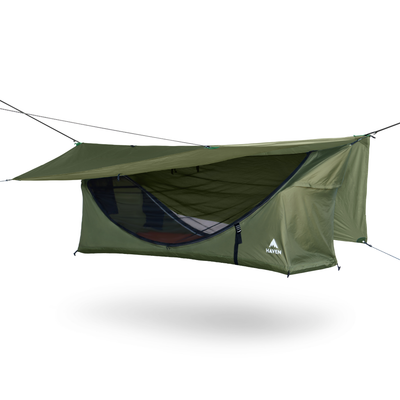
| Lay-flat hammock tent | Shelter, bug net, rainfly, flat bed and insulated pad | Sleeping bag or quilt, pillow | Two trees, a stand or hitch mount; on the ground in bivy mode |
Check two things in particular: whether it keeps you warm underneath, and whether it includes its own shelter. Our hammock tent gear checklist lists every piece side by side.
Pads, cots and off-the-ground beds compared for comfort
Whatever system you build, comfort comes down to the surface: how well it spreads your weight, how firm and flat it is, how easy it is to get in and out of, and what you can carry.
| Surface | Pressure relief | Getting in and out | Transport | Best for |
|---|---|---|---|---|
| Inflatable air pad | Good when thick; can feel bouncy | Down to the floor | Packs small | Backpacking; side sleepers who choose a thick one |
| Self-inflating foam pad | Good; stable and quiet | Down to the floor | Bulkier | Car camping, short carries |
| Closed-cell foam pad | Firm; thin | Down to the floor | Light but bulky; can't puncture | Back sleepers, or under another pad |
| Cot (plus pad) | Firm, taut fabric; better with a pad on top | Easiest: sit down as on a chair | Heavy and bulky | Car camping, people who find the floor hard |
| Traditional hammock | No hard points, but you lie in a curve | Can swing as you get in | Light | Back sleepers comfortable lying diagonally |
| Lay-flat hammock tent | Flat air pad, nothing hard underneath | Sit on the low side wall, then lie back | One kit, heavier than a bare hammock | Side and stomach sleepers, rough or wet sites |
Why the flat platform matters: in a gathered-end hammock the fabric curves you into a banana shape and squeezes in at the shoulders, which is why many side and stomach sleepers give up on hammocks. A lay-flat design holds an insulated air mattress flat in a suspended frame, so you can lie on your side or stomach and roll over much as you would on a bed, without touching the ground. On the ground, a narrow pad does the same job only if it's thick enough and the spot is level. More in Hammock vs Cot vs Sleeping Pad.
The top layer: sleeping bag, quilt or bed-style
- Mummy sleeping bag: the warmest for its weight and seals out drafts, but it's snug and restricts movement.
- Rectangular bag: more room to move and bend your knees; heavier and bulkier for the warmth. Good for car camping.
- Quilt: no insulation underneath you (it would be crushed anyway), so it relies on your pad. Lighter and easier to move in; can let drafts in at the edges unless it straps to the pad.
- Bed-style sheet and quilt: a fitted sheet on the pad and a quilt on top feels most like home and suits side sleepers and people who hate mummy bags.
Choose the rating by the comfort temperature for the coldest night you expect, and bring a real pillow when you can; it makes more difference than people expect.
All-in-one sleep system vs tent + sleeping pad
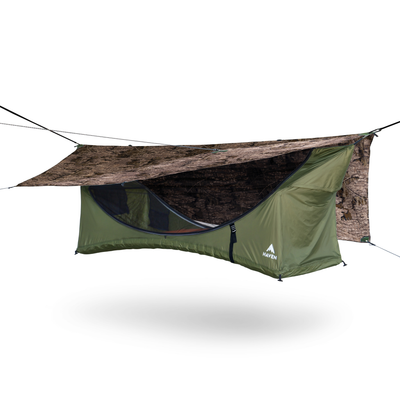
The Haven is the all-in-one example we know best: a hammock body with a built-in bug net, a waterproof rainfly and an insulated air mattress held flat in a suspended frame. You add your own sleeping bag or quilt. Here's how that compares with the usual tent-and-pad setup.
| All-in-one (lay-flat hammock tent) | Tent + sleeping pad | |
|---|---|---|
| What you buy | One kit: shelter, flat bed and insulated pad | A tent and a pad chosen separately |
| Sleeping surface | Flat, off the ground | Flat, on the ground |
| Rocks, roots and slope | Don't matter when hung | You need a clear, level spot |
| Side and stomach sleeping | Designed for it | Depends on pad thickness |
| People | One per Haven | One to several in one tent |
| Where it works | Two trees, a stand or a hitch mount; on the ground in bivy mode | Anywhere flat enough to pitch |
| Flexibility | Parts are designed to work together | Mix and match, upgrade one part at a time |
| Weight | Heavier than the lightest tent-and-pad combinations | From ultralight to heavy |
When a tent and pad is the better choice
- You want to share a shelter with a partner or kids.
- You often camp above treeline, on open beaches or in the desert and don't want to carry a stand.
- You want the lightest possible one-person setup.
- You expect to spend long storms sitting inside.
These are also listed on our Haven vs Ground Tents page.
When an all-in-one system is the better choice
- Sleeping well is your main reason for upgrading.
- Your campsites have trees, or you car camp and can bring the Haven Stand or a hitch mount.
- You'd rather not research, match and carry separate pads, tarps and nets.

Matching the system to the trip
- Warm-weather car camping: almost anything works; comfort and space matter more than weight.
- Cold nights: put your effort into insulation underneath, since that's where most heat is lost. Why that applies even off the ground: Do You Need a Sleeping Pad If You Sleep Off the Ground?.
- Backpacking: weight and pack size count, so compare complete systems, including pad and rain protection.
- No trees: a ground tent and pad, a tent cot or a vehicle setup; a Haven needs a stand, a hitch mount or bivy mode.
- Two or more people: one tent can be shared; all-in-one hammock tents sleep one each.
- Side or stomach sleepers: a flat surface matters most: a thick pad on level ground, or a lay-flat hammock tent.
- Getting up from the floor is hard: a cot with a pad, or a low-hung lay-flat hammock tent.
Choosing a Haven sleep system
- Haven Tent: 24 x 78 in platform, the most compact, best for people under about 180 lb; Premium pad (R5); rated to 285 lb.
- Haven XL: 30 x 80 in platform for larger builds and taller campers; True Level pad (R5.3); rated to 285 lb.
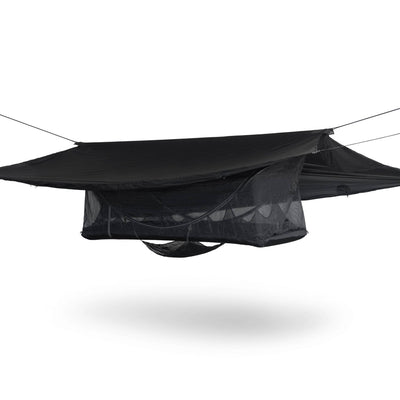
- Haven Spectre: the 30 x 80 in platform in our lightest kit, for backpacking; Spectre pad (R2.5); mesh body that isn't waterproof, so its rainfly does the weather work; rated to 285 lb.
- Haven Safari: 30 x 80 in, 300d polyester canvas and a 350 lb rating for car camping and basecamps; True Level pad (R5.3).
Every Haven sleeps one person and hangs from two trees, the Haven Stand or a hitch mount, or pitches on the ground in bivy mode. You add your own sleeping bag or quilt; the Insulated Pad Cover adds warmth underneath for cold trips.
Our outdoor sleep systems page shows the full lineup and the add-ons (pad covers for cold weather, stands and mounts). Still deciding? Read Are Lay-Flat Hammocks Worth It?, Hammock vs Cot vs Sleeping Pad or How to Choose a Camping Shelter.
Common questions
What is an outdoor sleep system, and do I need one?
It's your shelter, the surface you sleep on, the insulation under you and the bedding on top, chosen to work together. Everyone who sleeps outside needs all four. For mild trips a tent, an insulated pad and a suitable bag are enough; cold, wet or weight-sensitive trips need more careful choices.
What's the best camping sleep system for comfort?
It depends on how you camp. For car camping, a thick insulated mattress or a cot with a pad, with roomy bedding and a real pillow. For backpacking, the thickest insulated pad you're willing to carry and a bag or quilt rated for the low. If you sleep on your side or stomach and camp among trees, a lay-flat hammock tent gives you a flat, insulated bed off the ground.
What is the best all-in-one camping sleep system?
There isn't one for every camper. If you want shelter, bug and rain protection and an insulated flat bed in a single kit, a lay-flat hammock tent such as the Haven is the most complete option, for one person per kit. Families and couples sharing a bed are better served by a tent with a mattress or bed-style pad and quilt; ultralight backpackers by a modular tent, pad and quilt.
Do I need a sleeping pad in a hammock?
Yes, or an underquilt, on anything but warm nights, because moving air under you pulls heat away. A Haven includes an insulated pad. See Do You Need a Sleeping Pad If You Sleep Off the Ground?
Sleeping bag or quilt?
A mummy bag is warmest for its weight and seals out drafts. A quilt is lighter and roomier but relies on your pad underneath. For car camping, a rectangular bag or a sheet and quilt feel most like a real bed.


Comments (0)
No comments yet — be the first!
Leave a Comment